
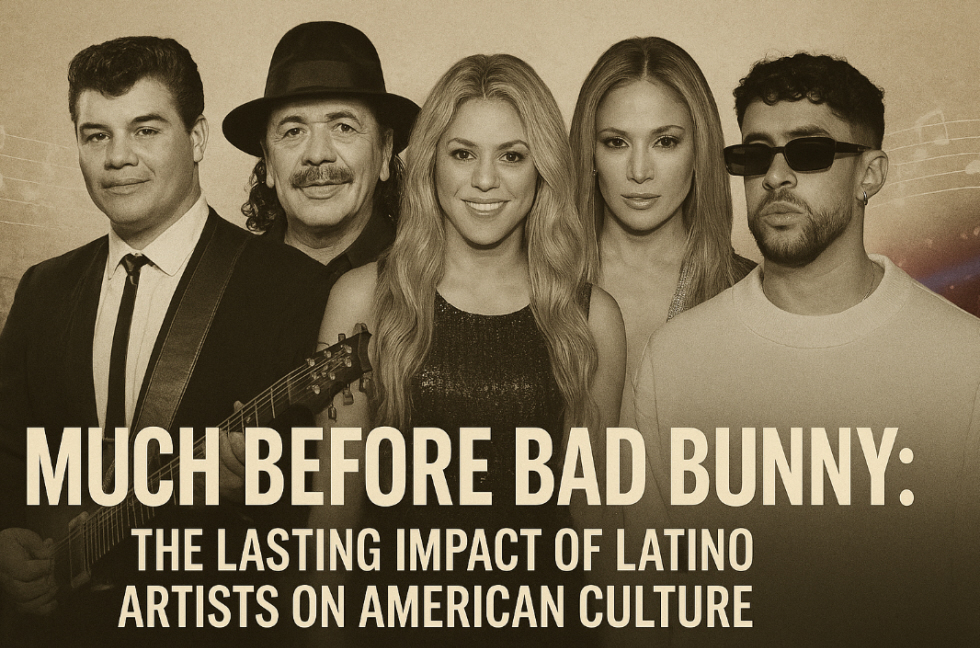
Long Before Bad Bunny: The Indelible Legacy of Latino Artists in American Culture
Editorial Commentary – NewsXX1
I. More Than an Artist — A Historical Continuity
The debate over Bad Bunny’s Super Bowl appearance should not hinge on whether he “deserves” the stage. His presence is, in fact, the outcome of a long history of Latino artists who earned space where Spanish once had none. To defend him today is to defend the cultural dignity of a community that has paved the way for more than seventy years.
II. The Pioneers Who Changed America’s Sound
Long before “reggaetón,” Latino artists were reshaping American music. Ritchie Valens brought Spanish into rock and roll with “La Bamba” at age 17. Carlos Santana made history at Woodstock with a fusion of rock, blues, and Latin percussion, later crowned by Supernatural. In the 1980s, Gloria Estefan and The Miami Sound Machine opened mainstream pop to Latin rhythm; Selena Quintanilla blurred the line between English and Spanish; and by the late 1990s, Jennifer Lopez, Ricky Martin, Marc Anthony, and Shakira cemented the Latin wave as a global force.
III. Bad Bunny: The Natural Heir
Bad Bunny did not appear out of thin air—he inherits that lineage. What sets him apart is his refusal to conform: he doesn’t translate his art to please the Anglo market. He sings in Spanish, keeps his accent, and proudly claims his Puerto Rican identity. His success rests on a generation that no longer seeks permission to exist in its own language.
IV. Prejudice Disguised as Criticism
It isn’t the first time a Latino artist is deemed “not American enough.” Santana was called a foreigner; Gloria Estefan was told her rhythm “didn’t fit”; Selena was criticized over English. Today, Bad Bunny is attacked for singing in Spanish. History shows those criticized yesterday become admired tomorrow.
V. A Land That Was Ours Too
Much of today’s United States was explored, inhabited, and administered by Spaniards long before Anglo expansion. California, Texas, New Mexico, Arizona, Nevada, Colorado, and Florida were Hispanic territories for centuries. Cities like Los Angeles, San Francisco, Santa Fe, and Las Vegas retain their Spanish names. When Bad Bunny sings in Spanish at the Super Bowl, he isn’t invading an American stage—he is returning to one that was already Latino.
VI. Seven Decades, One Language
For over seventy years, the Anglo-American mainstream has had the time and resources to learn Spanish; many chose not to. Four months before the Super Bowl, it is telling that the controversy is the headliner’s language, not the nation’s capacity to understand its own people.
VII. Bilingualism and the Mask of Conformity
We can no longer hide a lack of intellectual curiosity behind the phrase, “This is America, and here we speak English.” That slogan, wielded like a patriotic shield, is not identity—it is a mask covering intellectual poverty and cultural blindness. In the twenty-first century, not speaking Spanish in the United States is not patriotism; it is regression.
Practical conclusion: given English’s dominance across state powers, everyone—from the President to the janitor sweeping the Capitol halls—should be bilingual. Only then can the United States truly call itself a nation for all.
VIII. Closing
Bad Bunny is not an anomaly—he is the living continuation of a tradition that began with Ritchie Valens and endures in every Latino who sings, teaches, creates, or works in this land. Defending him today is not about a performance; it is about defending the memory of millions who continue to speak, dream, and love in Spanish within the United States.
Before Bad Bunny: One Voice, One Language
“From Ritchie Valens to Bad Bunny — a voice that never stopped singing.”
🎧 Listen only — editorial production by La Cruz del Sur — WV.
“La Bamba” — Ritchie Valens
The song that opened the doors of Spanish to the heart of America.
🎧 Listen only — included for cultural and historical reference.
© La Cruz del Sur — WV. Editorial tribute to the pioneers of Latin music.

