
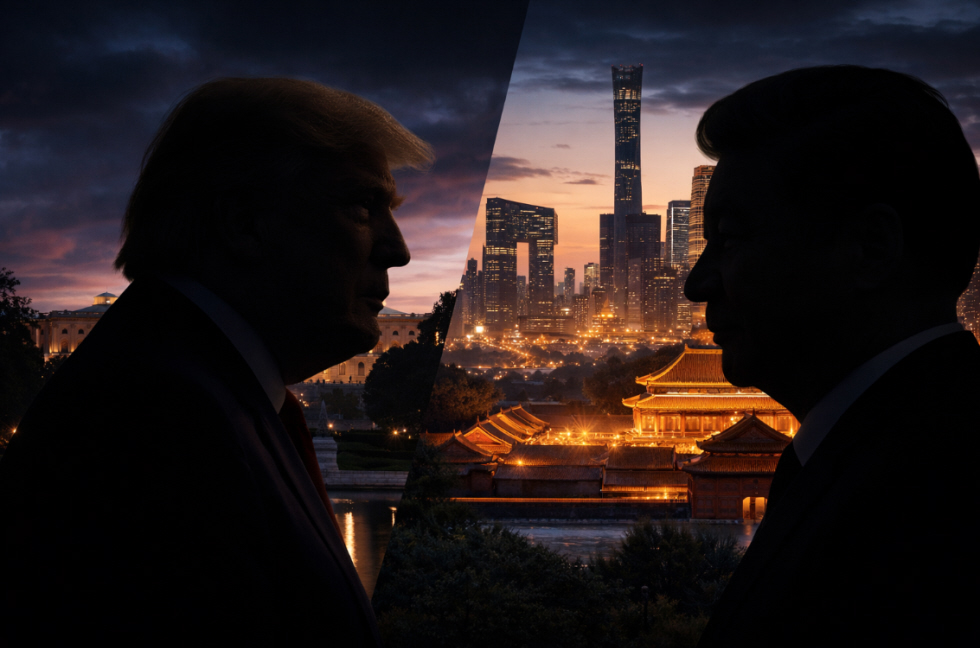
President Donald Trump is preparing for a high-profile visit to Beijing next month in what could become one of the most consequential diplomatic moments of his second term. The White House has framed the trip as a historic engagement, suggesting it may feature one of the most significant displays of ceremony and symbolism in recent U.S.–China relations. Yet the political and economic landscape surrounding the meeting has shifted dramatically.
A recent Supreme Court ruling weakened part of the legal foundation supporting Trump’s sweeping tariff regime, a central pillar of his broader strategy toward Beijing. While the decision did not dismantle his trade policy entirely, it placed limits on certain executive mechanisms used to impose expansive tariffs under emergency economic authorities. The ruling forced the administration to recalibrate just as bilateral negotiations enter a sensitive phase. In response, Trump moved quickly to preserve his hardline posture, announcing a new 15 percent global tariff over the weekend.
However, when the measure took effect Tuesday, it was implemented at 10 percent — a lower rate than originally promised. That adjustment did not go unnoticed. The gap between political rhetoric and policy execution signaled that institutional constraints are now shaping the administration’s trade tools more visibly than before. Analysts view the development as evidence that presidential authority in this arena may face tighter judicial scrutiny moving forward. Despite the setback, the White House has emphasized that it retains alternative levers to apply economic pressure on China.
These could include targeted trade restrictions, expanded technology controls, or additional sector-specific measures designed to influence strategic industries. On the Chinese side, the response has been measured. Beijing has not publicly confirmed the anticipated late-March meeting between Trump and President Xi Jinping, even as Washington released specific dates. Behind the scenes, Chinese officials are believed to be reassessing how the legal shift in the United States may affect the balance at the negotiating table. Foreign policy experts suggest the Supreme Court’s decision introduces a new dynamic into U.S.–China relations.
By limiting the president’s ability to deploy tariffs unilaterally and rapidly, the ruling reduces an element of unpredictability that had defined much of Washington’s recent trade approach. This evolving legal framework may influence the tone of the upcoming talks. Chinese negotiators could interpret the decision as a sign that executive trade authority is subject to stronger institutional checks, potentially altering expectations around leverage and concessions.
As the anticipated meeting approaches, both leaders face strategic calculations. Trump aims to project economic strength and resolve before sitting down with Xi, while Beijing evaluates how to navigate a U.S. trade policy that remains assertive but now operates within clearer judicial boundaries. In the broader geopolitical context, the episode underscores the complex interplay between domestic legal structures and international power politics.
Even as global markets watch for signals of stability or escalation, the next phase of U.S.–China negotiations will unfold under a recalibrated balance of authority — one shaped not only by diplomacy, but by constitutional limits at home.


