
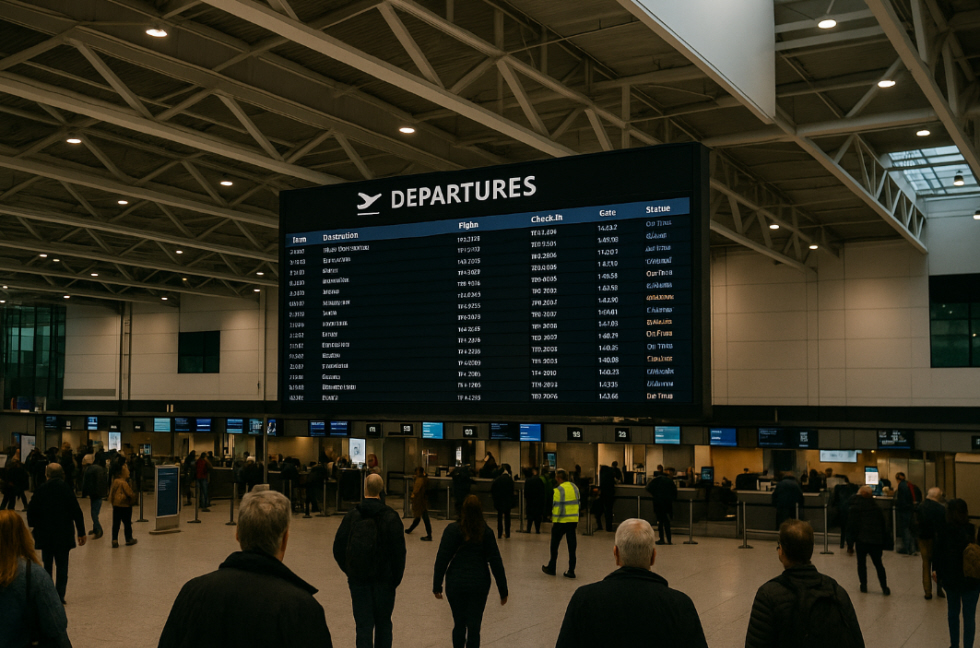
The effects of a large-scale cyberattack continue to disrupt airport operations across Europe, leading to hundreds of cancellations and delays that began on Friday night. The target of the attack was Collins Aerospace, a U.S.-based technology provider that plays a critical role in aviation services and also develops systems for military applications. Since the incident, major airports including Berlin, Brussels, Dublin, and London Heathrow have reported significant disruptions to passenger processing, resulting in long lines and considerable inconvenience for travelers.
Collins Aerospace confirmed that the outage was due to a “cyber-related disruption” affecting several European airports. However, the company has not provided details on the scope of the attack or who might be responsible. The aerospace firm, known for manufacturing components and developing specialized software, stated that it is working intensively to restore services, though no clear timeline has been given for a full resolution.
In Berlin, the city’s main airport reported on Sunday evening through its website that passengers were experiencing unusually long waiting times due to technical malfunctions. Online check-in remains available, and airport authorities advised travelers to use self-service kiosks and baggage drop-off machines whenever possible. Nonetheless, these options are not suitable for passengers with reduced mobility, families traveling with strollers, or those carrying oversized luggage, who must continue to rely on staffed check-in counters.
In Ireland, Dublin Airport experienced an additional incident on Saturday morning when one of its terminals was temporarily evacuated for security reasons. While the operator did not provide specific details about the evacuation, it clarified that the broader cyber disruption had only minor effects on the airport’s overall operations. Other major airports, such as Vienna and several German hubs outside of Berlin, were reportedly not affected by the system failure.
Germany’s Federal Office for Information Security (BSI) emphasized that despite the inconveniences, aviation safety has not been compromised. All air traffic control systems and security protocols remain fully operational. The incident underscores once again the vulnerability of critical infrastructure to cyberattacks and highlights the urgent need to strengthen digital defenses in the aviation sector, where millions of passengers rely daily on automated systems for both efficiency and safety.


