
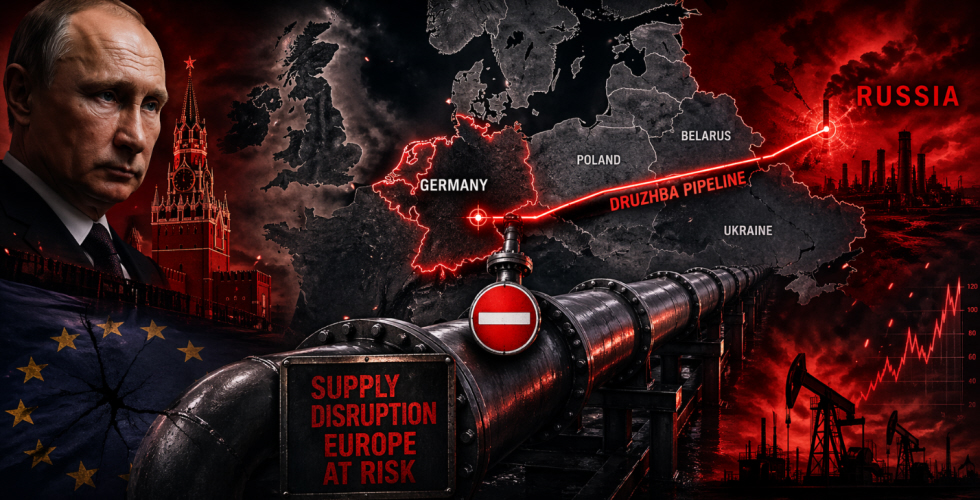
Russia has intensified pressure on Europe by disrupting a critical energy flow supplying Germany. Moscow announced the suspension of Kazakh oil transit through the Druzhba pipeline, one of the continent’s most important energy infrastructures. The measure is set to take effect within days and directly impacts key refineries. The move comes at a moment of heightened global energy tension. Although the affected oil is not of Russian origin, its transport depends on infrastructure controlled by Moscow. This reinforces the Kremlin’s ability to influence European energy supply without exporting its own resources.
Germany had relied on this route as an alternative after reducing dependence on Russian crude. That option is now temporarily constrained. Russian authorities have attributed the suspension to technical reasons, but the broader context suggests a decision with strong geopolitical implications. The move aligns with a global landscape marked by conflict and strategic uncertainty. Europe remains vulnerable due to its reliance on legacy infrastructure. Control over routes continues to serve as a powerful leverage tool. The Druzhba system, considered one of the world’s largest pipeline networks, has for decades been a cornerstone of Europe’s energy supply.
Its partial disruption raises concerns over market stability and price volatility. Beyond the physical volumes affected, the signal itself impacts confidence. Markets react as much to perception as to reality. This development unfolds alongside global disruptions linked to tensions involving Iran. Ongoing instability in the region has already increased oil market volatility worldwide. Europe now faces a dual challenge: logistical constraints and geopolitical risk at the same time. The situation complicates strategic energy planning. Germany has stated that its immediate energy security is not at risk, citing alternative supply routes through Baltic ports.
However, these solutions come with higher logistical costs and longer delivery times. Analysts warn that the impact could gradually reflect in domestic pricing. Stability now depends on flexibility and rapid adaptation. From a strategic perspective, Moscow’s message is clear: control over infrastructure remains a decisive factor. Even without direct exports, Russia retains the ability to shape European energy dynamics.
Energy continues to be a central instrument in geopolitical competition. Structural dependence has not yet been fully eliminated. In this environment, Europe is accelerating efforts to diversify suppliers and strengthen energy independence. However, the transition requires time and significant investment. In the meantime, episodes like this highlight the fragility of the current system. The continent’s energy balance remains influenced by external decisions.


