
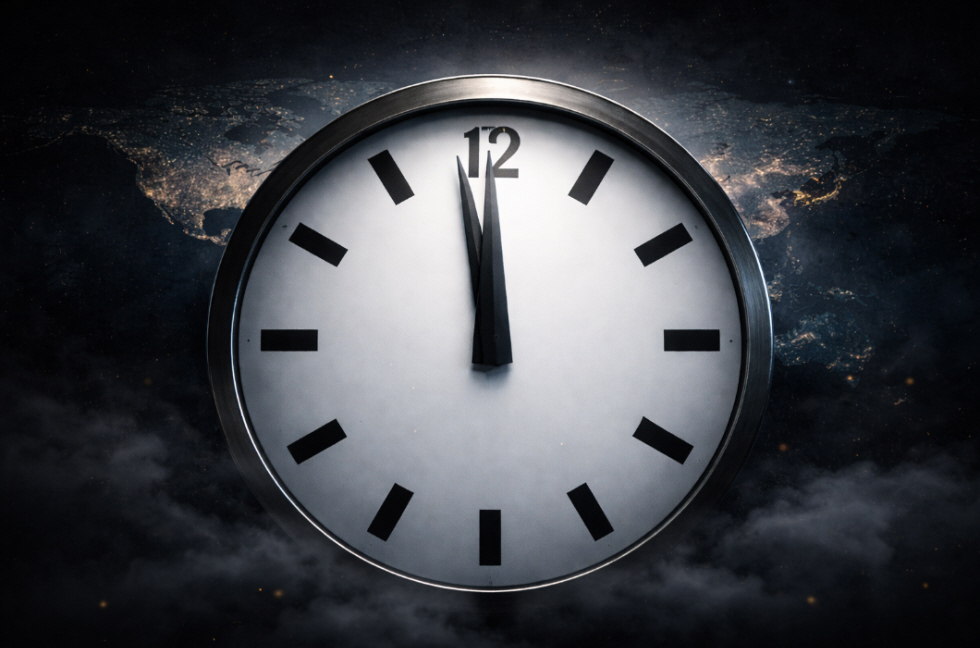
The Doomsday Clock has been set to 85 seconds before midnight, the closest point to global catastrophe since the clock was created in 1947. The adjustment reflects a growing concern over the world’s ability to manage the dangers it has created for itself. Scientists responsible for the clock warn that the planet is facing an unusually fragile moment, shaped by overlapping crises that are no longer isolated.
In their assessment, failures in global leadership have weakened collective responses to threats that have been widely recognized for years. A central concern is the escalation of tensions among major nuclear powers. Strategic rivalry between the United States, Russia, and China has once again placed nuclear risk at the forefront of international relations, in an environment defined by mistrust rather than cooperation. At the same time, international arms control frameworks have steadily eroded.
Longstanding agreements have been abandoned, suspended, or left without renewal, reducing safeguards that once helped prevent miscalculations and dangerous escalations. Climate change remains another critical factor in the assessment. Despite repeated scientific warnings, global efforts to reduce emissions and limit warming continue to fall short, increasing the likelihood of irreversible environmental and social damage. Experts are also increasingly concerned about the rapid development of disruptive technologies such as artificial intelligence and biotechnology.
While these tools offer significant benefits, their accelerated deployment without adequate oversight introduces new and poorly understood risks. Taken together, these challenges place humanity in a position of unprecedented vulnerability. The likelihood of catastrophe driven by nuclear conflict, climate breakdown, or the interaction of multiple crises is now higher than at any point in recent history.
The Doomsday Clock is not intended to predict the future or announce an inevitable outcome. Instead, it serves as a symbolic warning, measuring how close the world is to extreme danger and underscoring that human decisions remain central to whether that moment is delayed or brought closer.


