
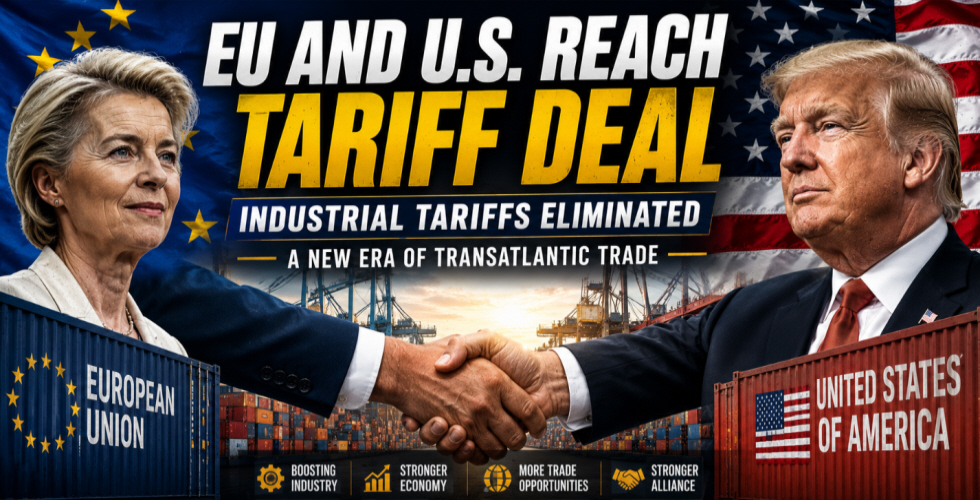
The emerging customs agreement between European Union and United States is now being viewed as one of the most significant economic developments between the two Western powers in recent years. Representatives from the European Parliament and the Council of the 27 EU member states reached an understanding aimed at eliminating tariffs on American industrial products. The measure represents a major step toward a new phase of transatlantic economic cooperation following recent negotiations linked to Donald Trump.
The agreement seeks to reduce commercial tensions while strengthening trade flows between two of the world’s largest and most influential economic markets. Among the sectors expected to benefit the most are the automotive industry, heavy machinery, industrial technology, manufacturing exports, and international logistics networks. Analysts believe the removal of tariff barriers could stimulate investment and significantly expand bilateral trade over the coming years. The development is also being interpreted as an important political signal during a period marked by geopolitical tensions, slowing economic growth, and increasing global competition.
Brussels and Washington appear determined to build a more stable economic partnership in response to challenges coming from other major global powers. Over recent years, commercial relations between Europe and the United States experienced repeated tensions involving tariffs, industrial subsidies, and technological disputes. However, the new agreement suggests a growing political willingness to rebuild trust and reinforce long-term strategic economic alliances. Global financial markets reacted carefully but positively to the possibility of a significant reduction in industrial tariffs.
Exporters, manufacturers, and multinational corporations could benefit enormously from lower trade costs and deeper economic integration between both sides of the Atlantic. At the same time, the agreement is generating concerns among several European sectors. Local industries, labor unions, and domestic producers fear that greater commercial openness could intensify American competition inside sensitive European markets and place additional pressure on local manufacturing.
Economic experts also warn that the agreement must still pass through several political and regulatory stages before being fully implemented. Nevertheless, the progress achieved between European representatives already reflects substantial support for expanding economic cooperation with Washington. The initiative could also produce broader global consequences by reinforcing the Western economic axis in the face of rising international fragmentation.
In an increasingly divided global economy, stronger coordination between Europe and the United States carries growing strategic importance. Although important steps still remain before the agreement becomes fully operational, the negotiations already represent a major shift in transatlantic relations. Europe and the United States appear to be entering a renewed phase of deep economic cooperation capable of influencing markets, industries, and the future balance of global trade.

