
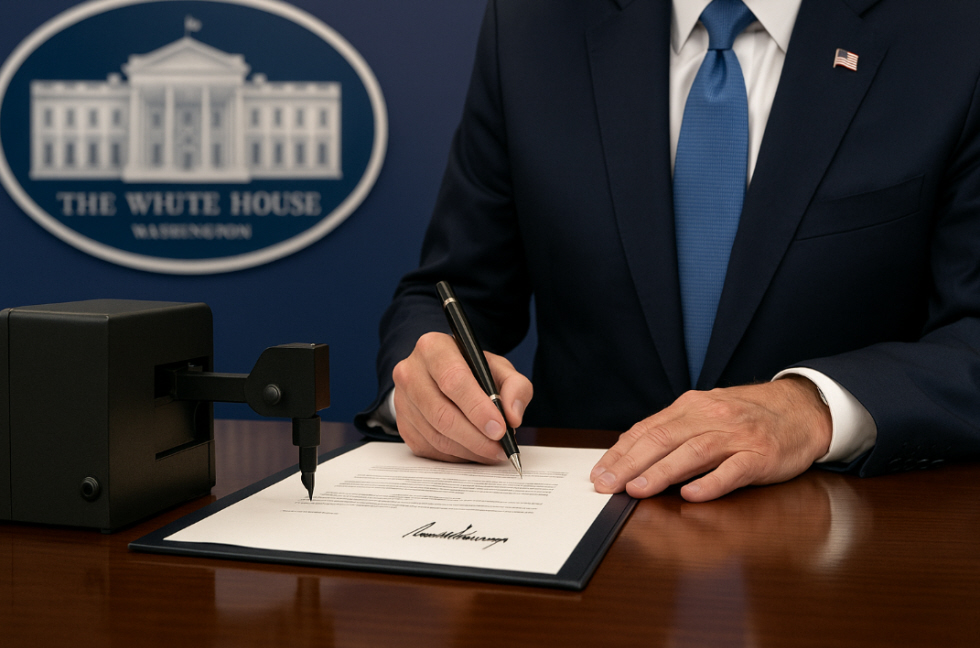
Political debate in the United States has intensified following the president’s announcement that he intends to review and potentially revoke a series of executive orders signed during the previous administration, arguing that a significant portion of those directives may have been authorized through an automatic signing device known as the Autopen. While the statement drew widespread media attention, constitutional law experts emphasized that any sitting president has full authority to modify or rescind executive orders issued by a predecessor regardless of how the signature was applied, as long as the documents in question are strictly executive orders.
That authority does not extend to other categories of presidential actions such as laws or pardons. The use of the Autopen is not new in American political practice. Multiple administrations have relied on this device to streamline the signing of high-volume or routine documents, and the Department of Justice clarified as far back as 2005 that a president is not required to personally hand-sign every document, provided that an authorized official has been instructed to apply the signature on the president’s behalf.
The current president’s remarks, however, revived a broader conversation about administrative transparency and procedural norms within the White House in recent years. The situation also unfolds against a backdrop of heightened political tensions, following an election cycle marked by public exchanges in which both sides questioned leadership style, decision-making, and the overall operational capacity of the previous administration.
Representatives of the former president rejected the allegations as unfounded and insisted that every decision taken during his tenure was deliberate, intentional, and fully compliant with legal standards, noting that the Autopen has long been used by various modern presidencies. Despite differing public narratives, analysts agree that the power to revoke or amend executive orders is a routine presidential prerogative and that the practical impact will depend more on the substance of the orders themselves than on the method used to affix the signature.
The episode highlights how technical administrative details can rapidly become politically charged issues, particularly during periods of transition and shifting dynamics within the U.S. political landscape.
By:
“NewsXX1 Editorial Team”


