
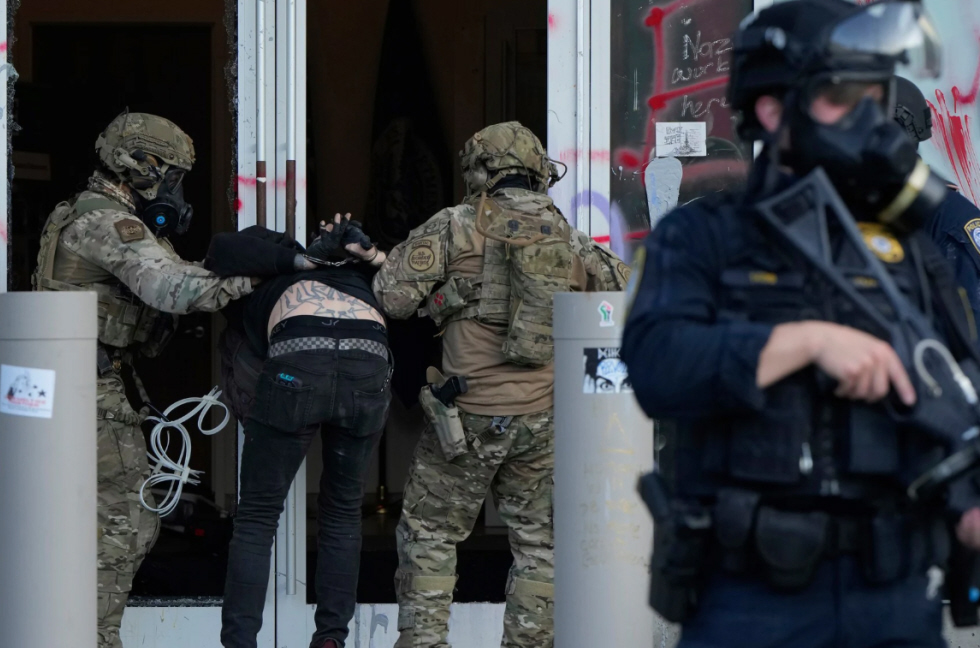
U.S. President Donald Trump on Saturday ordered the deployment of military forces to the city of Portland, Oregon, sparking a wave of controversy nationwide. According to the president, the city is “under siege and devastated by Antifa and other domestic terrorists,” which he argued justifies the mobilization of federal troops. In a post on his Truth Social platform, Trump said he had instructed Secretary of War Pete Hegseth to provide “all necessary troops to protect war-ravaged Portland and our ICE facilities.
” He also declared that he was authorizing the “use of large-scale force if necessary,” though he offered no further details on what such force would entail. Trump further stated that the order had been issued at the request of Homeland Security Secretary Kristi Noem. The decision was met with immediate resistance from local authorities. Portland Mayor Keith Wilson responded that “the number of troops needed is zero,” stressing that the city is not facing the level of violence described by the president.
Oregon Governor Tina Kotek also condemned the move, declaring that “Portland is fine” and that federal intervention is neither required nor justified. Several Democratic members of Congress from Oregon, including Suzanne Bonamici, Andrea Salinas, Val Hoyle, and Maxine Dexter, joined in criticism, sending a letter in which they called Trump’s order an abuse of executive power that threatens to escalate tensions unnecessarily and undermine the state’s autonomy.
Constitutional law experts have raised concerns that such actions may violate the Posse Comitatus Act, which restricts the use of the U.S. military in domestic law enforcement. Official data further complicates Trump’s justification, as violent crime and homicide rates in Portland have actually declined throughout 2025. Critics argue that the president is exaggerating security issues to consolidate power and impose an increasingly authoritarian style of governance.
This deployment is part of Trump’s broader domestic agenda, which in recent months has included similar orders sending National Guard units and federal forces to other cities such as Los Angeles, Memphis, and Washington, D.C. In each instance, the administration has claimed the moves were necessary to confront threats to public safety, while local leaders and civil rights groups insist they represent attempts to centralize federal power and erode state authority.
For Portland, the announcement has generated uncertainty and concern. While city officials maintain that no extraordinary security crisis exists, the federal government’s intervention could heighten tensions in a community that views the move less as a response to crime than as a political confrontation over control, security narratives, and the limits of presidential power in an era of deep national polarization.


