
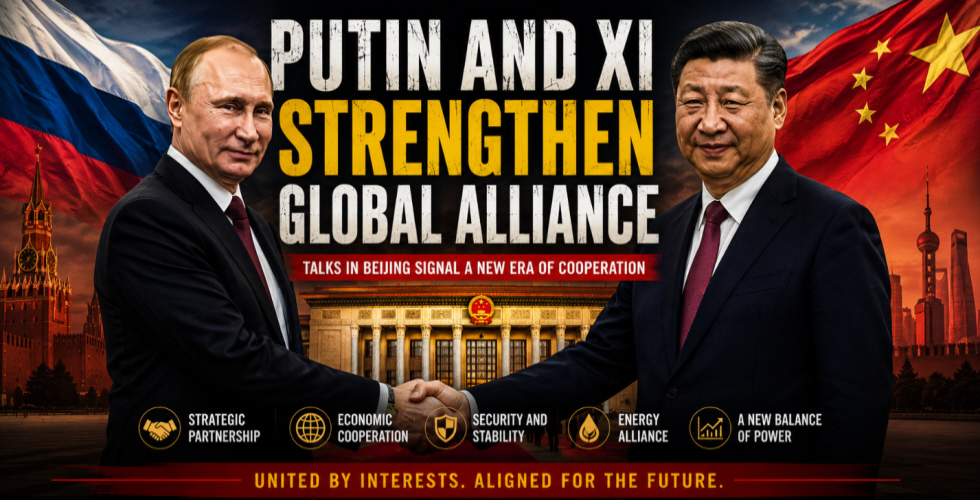
The meeting between Vladimir Putin and Xi Jinping at the Great Hall of the People in Beijing once again places China and Russia at the center of the global geopolitical stage. The talks come at a moment of growing international tensions marked by Western sanctions, regional conflicts, and an accelerating strategic rivalry among major world powers. According to official plans, both leaders will hold high-level discussions followed by a formal state reception hosted by the Chinese government.
The political symbolism of the meeting is enormous, especially because it demonstrates that Moscow and Beijing continue strengthening a strategic relationship that openly challenges traditional Western influence. The discussions are expected to focus on economic cooperation, energy partnerships, trade, technology, and international security issues.
Both presidents are also likely to address regional conflicts and sensitive geopolitical matters connected to the shifting balance of power currently emerging between East and West. Over recent years, Russia and China have significantly intensified their political and economic coordination. Western sanctions imposed against Moscow pushed Russia even closer toward Asia, while China continues expanding its diplomatic and commercial influence across multiple regions around the world. International analysts view this partnership as one of the most important geopolitical developments of recent decades.
Although Beijing and Moscow still maintain historical and strategic differences, both governments share a common interest in building a global order less dominated by the United States and its traditional allies. The summit also takes place during a period of growing uncertainty in the global economy caused by military conflicts, trade disputes, and energy instability. Russia remains one of the world’s major energy suppliers, while China continues consolidating its position as an industrial and technological superpower. Among the most closely watched topics on the bilateral agenda is financial and energy cooperation between the two nations.
Moscow and Beijing have increasingly pursued agreements designed to reduce dependence on the U.S. dollar in international transactions while strengthening alternative systems for global trade. At the same time, the growing alignment between Putin and Xi has raised concerns across several Western capitals. Some governments fear that an increasingly solid partnership between the two powers could eventually reshape military, economic, and diplomatic balances in strategic regions across Europe, Asia, and the Middle East.
The Beijing meeting also carries powerful symbolic weight because it projects an image of political stability and mutual coordination at a time when the international system appears increasingly fragmented. Both China and Russia are seeking to demonstrate unity in the face of external pressure and growing global uncertainty. As the world closely watches the summit, it is becoming increasingly clear that decisions made between Moscow and Beijing could deeply influence the future of the global economy, international diplomacy, and the balance of power that may define the next geopolitical decade.


