
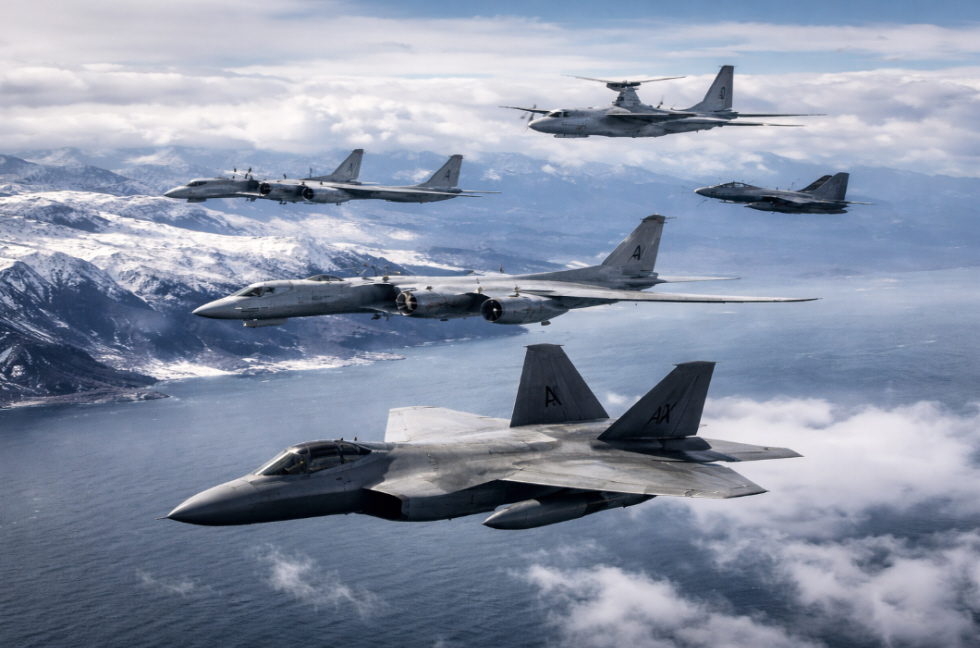
Russian bombers and fighter jets entered the Air Defense Identification Zone (ADIZ) off the U.S. state of Alaska, prompting a swift response from North American military aircraft tasked with interception and monitoring. The Russian formation reportedly included two long-range Tu-95 strategic bombers, two Su-35 fighter jets, and an A-50 airborne early warning aircraft operating in international airspace near North America.
In response, the North American Aerospace Defense Command activated standard identification and tracking procedures. Fighter jets were launched to intercept and escort the aircraft until they exited the defense zone. Among the assets deployed were F-16 and F-35 fighter jets, an E-3 AWACS early warning aircraft, and KC-135 aerial refueling tankers, reflecting a coordinated and routine air defense operation.
Military officials confirmed that the Russian aircraft did not enter sovereign airspace belonging to the United States or Canada, remaining at all times in international airspace. Such encounters occur periodically in strategically sensitive regions such as the Arctic and the North Pacific, where major powers conduct long-range patrols as part of their military posture.
An Air Defense Identification Zone is not sovereign airspace but a buffer area in which approaching aircraft are required to identify themselves for national security monitoring purposes. The incident takes place amid ongoing geopolitical tensions between Washington and Moscow, particularly in the strategic and defense domains.
While no territorial violation or hostile action was reported, these aerial interactions are closely monitored due to the potential for miscalculation or escalation. The interception and escort demonstrate established defense protocols designed to safeguard North American airspace and maintain readiness in the face of strategic approaches.


