
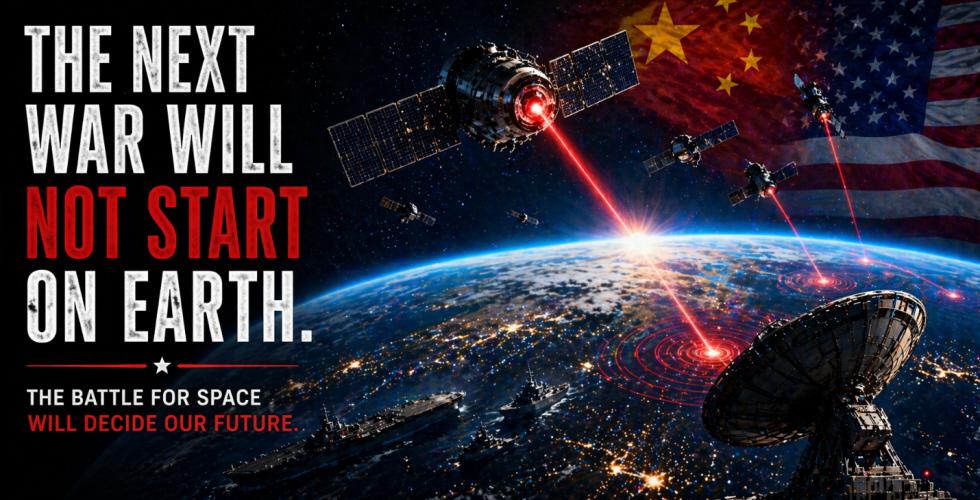
The new competition between global powers is no longer fought only across seas, skies, or land territories. Space has become the most strategic stage of global security, where every satellite represents a military advantage and every orbit can become a line of confrontation. The United States and China are watching that battlefield with growing tension. The next war could begin long before it reaches Earth. American military authorities have warned that China has developed advanced capabilities to strike U.S. and Australian forces from space.
According to senior commanders of the United States Space Force, Beijing has not only expanded its orbital presence, but has also tested systems designed to neutralize strategic targets across the Pacific. The warning is no longer presented as a distant possibility, but as a reality that demands immediate attention. Lieutenant General Gregory Gagnon, who leads combat operations for the U.S. Space Force, stated that China now possesses the world’s largest space force. According to his remarks, its orbital infrastructure is three times larger than America’s in some critical areas.
The speed of that expansion has surprised even those accustomed to constant military competition. The strategic balance is beginning to shift quietly. One of the most concerning elements is the network of surveillance and tracking satellites that Beijing has deployed to monitor naval movements in real time. Aircraft carriers, destroyers, and battle groups could be identified with precision from orbit, reducing the maneuvering space of allied forces. Traditional naval superiority loses value when the enemy can observe every movement. The sky becomes a permanent radar. The United States recognizes that the response cannot be limited to traditional defense.
For that reason, Washington has approved the largest military space budget in its history, seeking to strengthen satellites, orbital defense systems, and new counterstrike capabilities. The investment reflects a deep doctrinal transformation. National security now depends not only on armies and fleets, but also on invisible constellations above our heads. Australia has also entered that equation. As a strategic partner of Washington in the Indo-Pacific, Canberra is closely watching China’s technological rise and the vulnerability of its own defense capabilities. Military space cooperation between both countries has intensified.
Regional security now requires looking upward, not only across the sea. China, for its part, argues that its space development responds to legitimate security needs and technological progress. However, Western perception changes when those capabilities are combined with increasingly sophisticated military programs. The line between scientific exploration and power projection becomes thinner every year. In the 21st century, technology is rarely neutral. History shows that every arms race eventually reshapes the international order. During the Cold War, nuclear and space competition between Washington and Moscow transformed the planet.
Today, the rivalry between the United States and China appears to follow a similar logic, but with far more advanced tools. The difference is that now conflict can begin without a single visible explosion. The militarization of space also raises a legal and moral challenge. International treaties were designed in another era, when orbital warfare still seemed like science fiction.
Today, those rules are insufficient against anti-satellite weapons, electronic interference, and total surveillance from orbit. International law is running behind a reality that is moving too fast. Beyond official speeches, the message is clear: the next great geopolitical dispute will not be only about territory, oil, or maritime routes. It will be about technological control, orbital dominance, and global surveillance capability. Space is no longer only a symbol of human exploration, but of absolute strategic power. The new frontier of war is already above our heads.


