
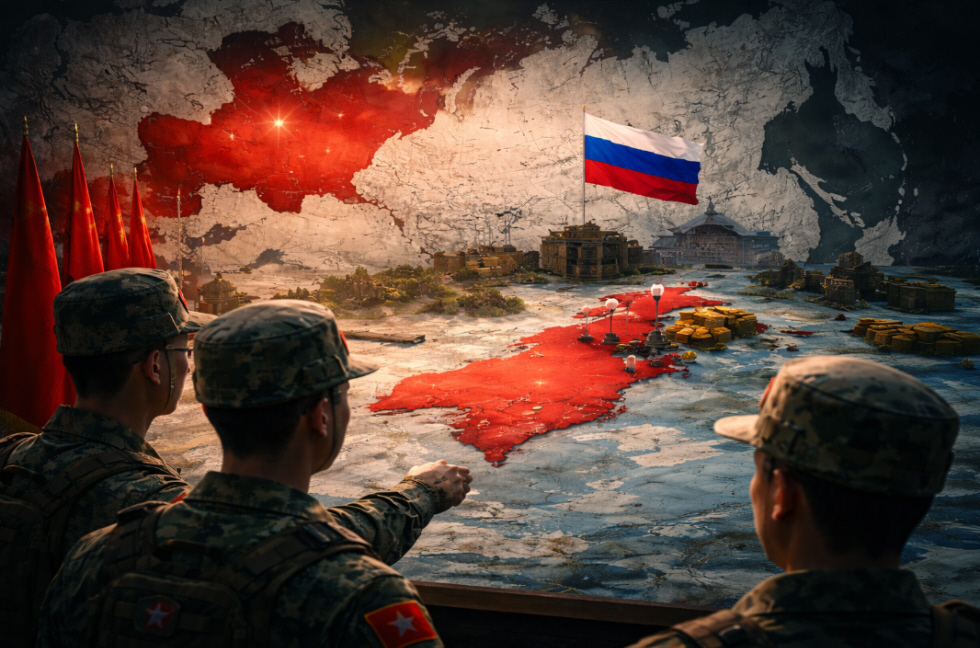
China could be encouraged to claim large portions of Russian territory if political and economic instability were to trigger a collapse of the Russian state. While such a scenario once seemed unthinkable, it is increasingly being discussed in strategic and academic circles as pressure on Moscow continues to mount. At the center of these considerations lies Russia’s Far East, a vast region covering nearly four million square miles, stretching from eastern Siberia to the Pacific Ocean. It is one of the largest and least populated territories on Earth, yet also one of the richest in natural resources.
The region contains some of Russia’s most valuable strategic assets, including gold, diamonds, oil, natural gas, and critical minerals essential for modern industries. Despite its immense size, the Far East is home to only around eight million people, creating a striking demographic imbalance. Across the border, China’s northeastern provinces host tens of millions of residents, alongside an economy heavily dependent on stable access to raw materials. This contrast has long fueled quiet strategic calculations, even during periods of official cooperation between Beijing and Moscow.
Although Russia and China currently maintain a close partnership driven by shared interests against Western influence, their historical relationship is complex. In the nineteenth century, the Russian Empire annexed large territories that had previously fallen under Chinese influence—an episode that still resonates in Beijing’s historical memory. Analysts suggest that in a scenario of central authority breakdown in Russia, China could justify territorial or administrative expansion under the guise of border security, economic stabilization, or protection of investments.
Such a move would likely take the form of gradual influence rather than open military conquest. Already today, much of the Russian Far East relies heavily on Chinese capital, trade, and labor, particularly in sectors such as mining, energy, agriculture, and infrastructure. In the event of a power vacuum, this economic presence could quickly translate into geopolitical leverage. For Beijing, securing direct access to these resources would carry not only economic benefits but also strategic and military significance, reducing China’s vulnerability to maritime chokepoints and tensions with the United States and its allies in the Indo-Pacific.
From Moscow’s perspective, this scenario represents one of the most serious long-term existential threats, potentially surpassing concerns over NATO expansion. Losing effective control over the Far East would fundamentally undermine Russia’s status as a Eurasian power. For now, the Kremlin maintains firm political and military control over the region. Yet a combination of demographic decline, prolonged sanctions, and institutional strain continues to raise questions about the sustainability of that control over time. China, for its part, avoids any public statements suggesting territorial ambitions toward Russia.
Officially, Beijing supports Russia’s territorial integrity, fully aware that a chaotic collapse could generate instability along its northern border. Still, in global geopolitics, power vacuums rarely remain unfilled. Should Russia experience severe weakening, the Far East could become one of the most significant territorial realignments of the 21st century, with China emerging as the actor best positioned to shape its outcome.


