
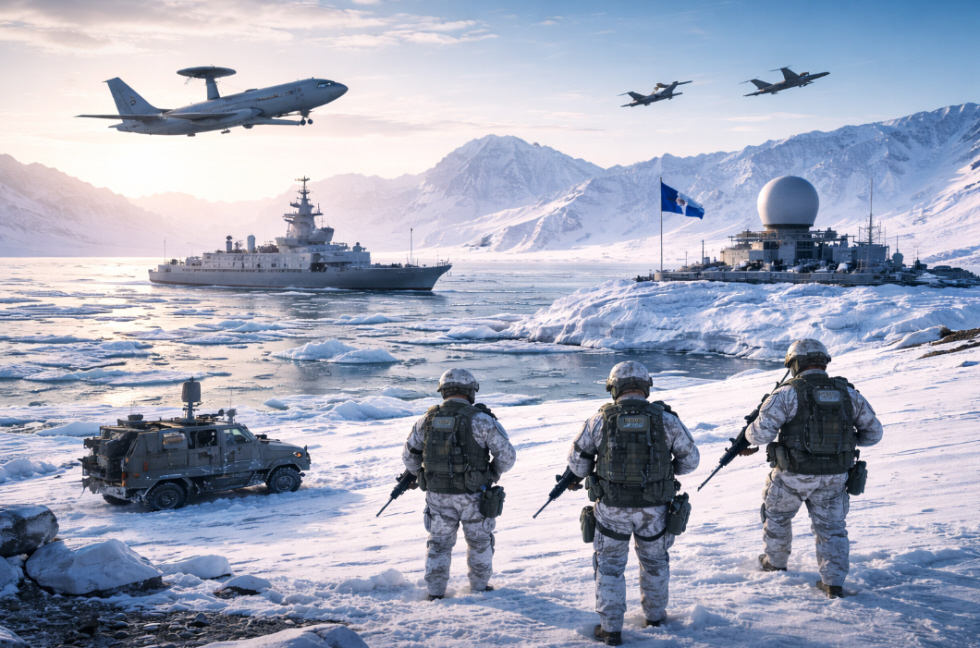
The debate over security in the Arctic and Europe’s role within NATO has gained renewed attention amid rising geopolitical tensions and Russia’s increased military posture in the region. In this context, several European countries are examining ways to strengthen their contribution to collective defense, always within the framework of the Atlantic Alliance and in close coordination with the United States.
Discussions have focused primarily on reinforcing the allied presence in the Arctic, a region of growing strategic importance due to security concerns, emerging shipping routes, and access to natural resources. The United Kingdom and Germany are among the countries engaging with other European partners to assess possible cooperative initiatives. Officials in London have emphasized that deterrence toward Russia remains a routine responsibility of NATO and that any additional measures in the north should be viewed as complementary, not a substitute for the United States’ longstanding commitment to European security.
Transatlantic cooperation continues to be regarded as essential to regional stability. In Germany, the government has reiterated its willingness to play a more active role in Arctic security, while making clear that all strategic decisions must be coordinated with allies. Berlin has stressed that these discussions do not signal an independent European military posture separate from the United States, but rather an effort to strengthen NATO’s overall credibility.
Some of the ideas under consideration include enhanced surveillance missions and closer coordination among allied forces, aimed at demonstrating Europe’s seriousness about collective defense. Government sources have noted, however, that these talks are largely political and diplomatic in nature, and do not involve plans for large-scale deployments or fundamental changes to NATO’s security architecture. At the same time, theoretical discussions have emerged about greater European financial participation in existing deterrence structures, without implying the development of national nuclear capabilities.
Germany, in particular, has reiterated that its international commitments prohibit a domestic nuclear weapons program, while allowing cooperation within multilateral frameworks. Experts agree that any discussion of nuclear deterrence in Europe must be understood as a long-term and highly complex process, one that remains fundamentally dependent on U.S. leadership and cannot replace the central role the United States plays within NATO.
Overall, these debates reflect Europe’s effort to assume greater responsibility within the alliance, reinforcing its position as a reliable strategic partner, while acknowledging that the security of both the Arctic region and the European continent continues to rest on transatlantic cooperation and the leadership of the United States.


