
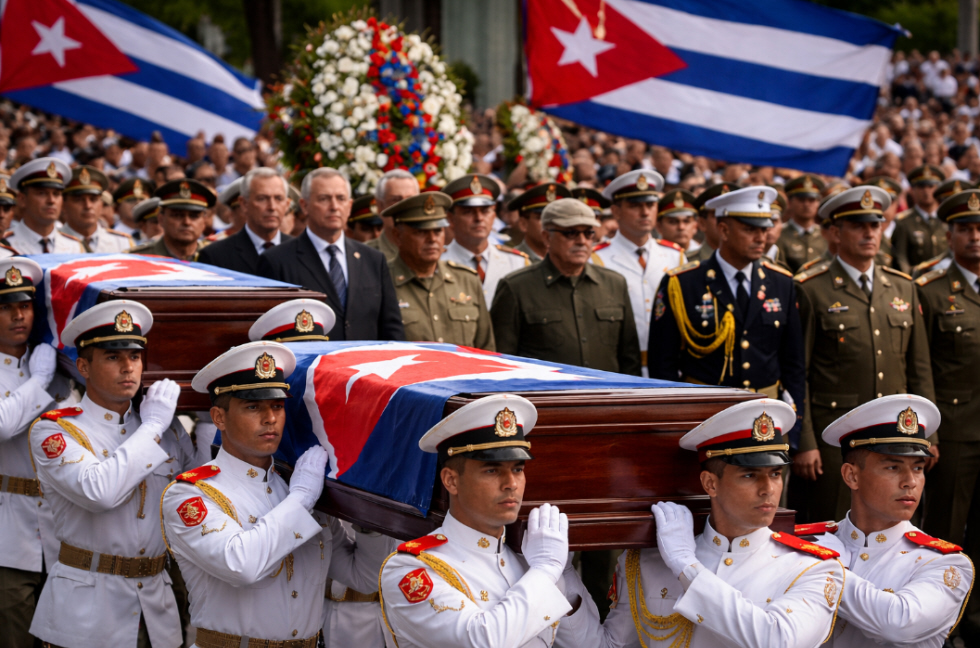
The remains of 32 Cuban soldiers who were killed during a U.S. military operation in Venezuela that ended with the capture of President Nicolás Maduro were returned to Cuba and received with a high-level official ceremony. The bodies arrived in small coffins and were honored in an event broadcast on state television. The ceremony was attended by Cuban President Miguel Díaz-Canel, former leader Raúl Castro, and senior military officials.
A military band and honor guard accompanied the proceedings, which the government framed as a solemn tribute to the fallen soldiers. During the event, General Lázaro Alberto Álvarez said the deceased soldiers symbolized Cuba’s commitment to its allies and to its international stance. In his remarks, he emphasized national dignity and resilience in the face of what authorities described as external pressure.
Following the ceremony, the remains were transported in a military motorcade through Havana’s main avenues to the Ministry of the Armed Forces. Large crowds gathered along the route, saluting and waving Cuban flags as the convoy passed. According to official information, 32 Cuban military personnel died during the operation that resulted in Maduro’s capture. One survivor recently described the events of the early morning of January 3, highlighting the speed and intensity of the intervention.
International reporting has indicated that in the months leading up to the operation, Maduro had expanded the role of Cuban personnel within his security detail, amid escalating political and diplomatic pressure from the United States. The return of the bodies and the state-led tributes have had a significant political and social impact in Cuba, where authorities have portrayed the episode as a moment of national mourning and reaffirmation of historical narratives regarding U.S. relations.
The incident adds a new layer of tension to relations between the United States, Cuba, and Venezuela, in a regional landscape already shaped by shifting political and military dynamics. The broader diplomatic consequences of the operation continue to draw international attention.


