
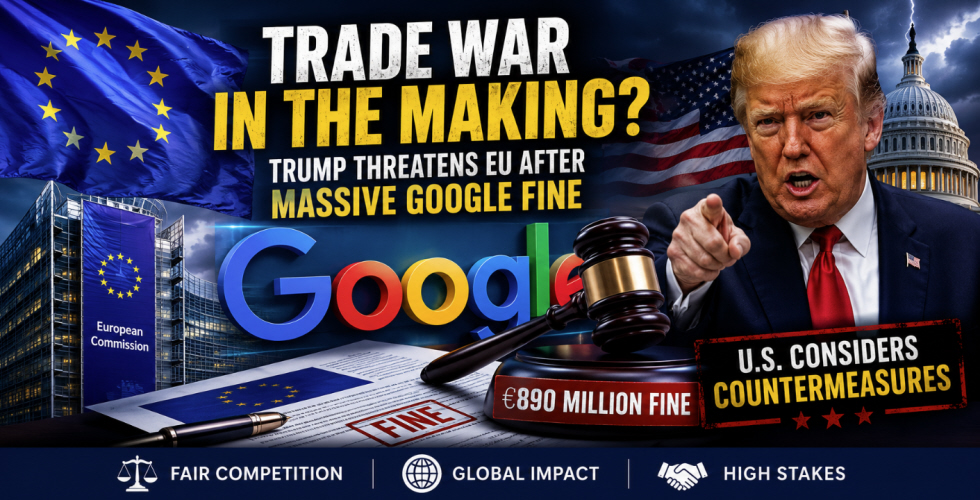
The European Union's decision to impose a multi-million-dollar fine on Google has reignited tensions between Brussels and Washington at a sensitive moment for the global economy. The penalty, based on European digital competition rules, once again places one of America's largest technology companies at the center of an international dispute. The move has also opened a new chapter in transatlantic relations. European officials argue that large digital platforms must operate under rules designed to ensure fair competition for businesses and consumers alike.
According to EU regulators, stronger oversight is necessary to prevent dominant technology companies from abusing their market position and limiting opportunities for smaller competitors across the digital marketplace. The response from Washington was swift. President Donald Trump sharply criticized the European decision, calling it an unfair action against one of America's most successful corporations. He argued that U.S. companies should not become repeated targets of what he described as excessive regulatory measures imposed by foreign governments. Trump also warned that his administration is reviewing possible responses to the European action.
Among the options being considered are trade investigations and additional measures aimed at protecting American companies operating in international markets. His comments suggest that the dispute could expand well beyond the technology sector. The conflict extends far beyond Google's case and highlights fundamentally different approaches to regulating the digital economy. While the European Union favors stricter oversight of major technology platforms, the United States has traditionally emphasized innovation, investment, and market-driven growth with fewer regulatory barriers.
Industry analysts believe the dispute could eventually affect other major American technology companies with significant operations across Europe. Businesses involved in artificial intelligence, cloud computing, digital advertising, e-commerce, and online services may face increased regulatory pressure as European authorities continue expanding their oversight of the digital sector. The possibility of an escalating trade dispute has raised concerns among investors and financial markets.
If both sides introduce retaliatory measures or additional restrictions, industries ranging from technology and manufacturing to international trade and investment could experience greater uncertainty in the months ahead. The controversy has also intensified the global debate over balancing technological innovation with government regulation.
Some governments view the European model as a necessary framework for protecting competition and consumer rights, while others believe excessive regulation could weaken innovation and reduce economic competitiveness. Beyond its immediate financial impact, the dispute carries significant political and geopolitical implications. Competition for technological leadership has become one of the defining challenges of the modern global economy, with regulatory decisions increasingly influencing international alliances, economic strategy, and corporate expansion.
As both Washington and Brussels prepare for their next moves, many observers believe this confrontation is only beginning. Future negotiations, trade discussions, and regulatory decisions will determine whether the two allies can resolve their differences through diplomacy or whether the disagreement evolves into a broader economic conflict with lasting consequences for the global technology industry.

