
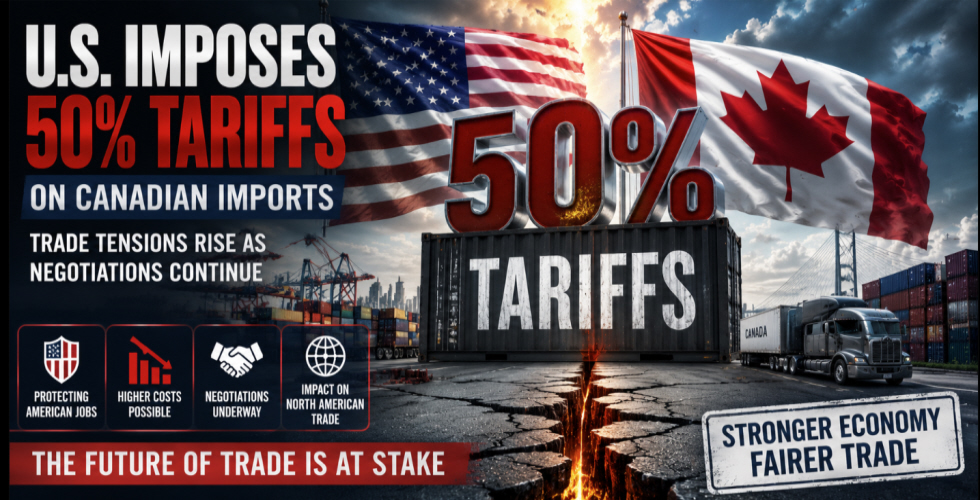
The administration of President Donald Trump has announced a new package of 50% tariffs on a wide range of imports from Canada, marking another significant step in U.S. trade policy. The decision is intended to strengthen domestic industries while addressing what Washington describes as unfavorable trade practices. Although several exemptions remain in place, the announcement has drawn widespread attention across global financial markets. The new tariffs are part of a broader strategy aimed at protecting American manufacturing and reducing reliance on selected imported goods.
According to the administration, the policy seeks to correct long-standing trade imbalances while creating more favorable conditions for U.S. producers. The initiative also reflects an effort to reinforce the competitiveness of industries considered vital to the nation's economy. Canada remains one of the United States' largest trading partners, with deeply integrated supply chains spanning the automotive, manufacturing, agricultural, and natural resource sectors. Any change in the rules governing bilateral trade has the potential to affect businesses, investors, and consumers on both sides of the border.
As a result, the announcement has generated considerable economic interest. Although the proposed tariff rate is substantial, many products will remain exempt from the new measures, limiting part of the overall economic impact. However, goods covered by the tariffs could become more expensive if importers pass the additional costs on to consumers. The final effect will largely depend on how businesses adjust their pricing and supply strategies. The automotive industry is expected to be among the sectors most closely watching the situation because of the highly integrated manufacturing network shared by both countries.
Many vehicle components cross the border multiple times before final assembly, meaning that higher costs could reduce efficiency throughout the production process. Industry leaders are expected to closely monitor future developments. Canadian officials have expressed their willingness to continue discussions with Washington before the tariffs are scheduled to take effect. Both governments recognize the importance of maintaining a stable trade relationship that supports millions of jobs and businesses that depend on cross-border commerce every day. Diplomatic negotiations remain the preferred path forward.
Economic analysts believe there is still room for both countries to reach an agreement that could lessen the impact of the proposed measures. Ongoing negotiations may ultimately alter both the tariff rate and the final list of affected products, providing opportunities for compromise while protecting key economic interests. The coming weeks will be critical for both sides. Financial markets are expected to closely follow every stage of the negotiations, as any shift in trade policy between the United States and Canada could influence industrial production, exporting companies, and international supply chains.
Periods of uncertainty often affect investment decisions while businesses wait for greater clarity regarding future trade rules. Beyond its immediate economic consequences, the announcement reflects a broader strategy by Washington to use tariffs as a negotiating tool in pursuit of trade conditions it considers more favorable for the United States. This approach is expected to remain a central issue in economic policy discussions throughout the coming months as global trade relationships continue to evolve.
As the implementation date approaches, businesses, investors, and consumers will continue watching negotiations between both governments with great interest. The outcome will not only shape the future of trade between the United States and Canada but could also influence economic stability across North America and affect broader international commercial relations.

