
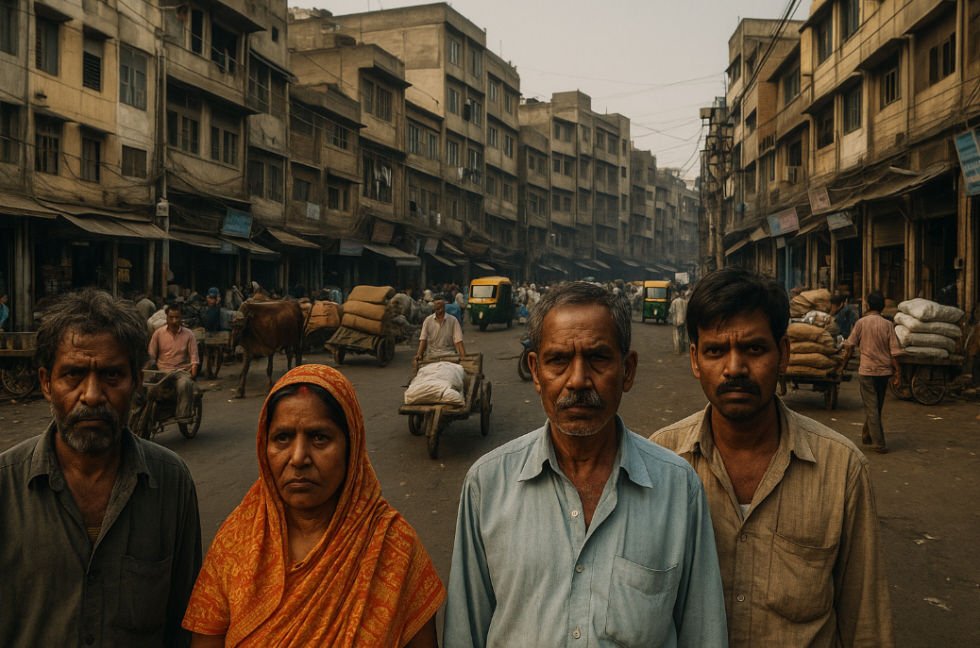
India’s economy is experiencing rapid expansion that positions it among the fastest-growing emerging powers in the world, driven by an unprecedented technological boom, a rising manufacturing sector, and a massive domestic market capable of sustaining demand even in times of global uncertainty. However, beneath this impressive dynamism lies a deep structural problem: India’s economic model is designed to maximize corporate profits rather than ensure that progress is shared equitably among its population.
The result is a clear paradox: a nation advancing powerfully toward modernity while most of its people remain trapped in poverty. Although India has opened its doors widely to international capital and has made it easy for global technology, manufacturing, and service companies to set up operations, the structure of growth remains concentrated in a few highly developed cities such as Mumbai, Bengaluru, Hyderabad, and Delhi. These areas enjoy modern infrastructure, higher-than-average salaries, and access to skilled employment, but they represent only a small portion of the country’s social landscape. The vast majority of India’s population lives in rural areas or underdeveloped regions where industry does not reach, public services are insufficient, and educational quality is uneven.
As a result, the benefits of growth remain trapped at the top, with no effective mechanisms to distribute them downward to those who need them the most. This reality is compounded by a labor market dominated by informality, where nearly 80% of workers lack contracts, legal protections, and basic employment rights. Under these conditions, even people who work hard remain vulnerable to poverty because there are no guarantees of stability, fair wages, or upward mobility. The education system, meanwhile, continues to be a decisive barrier: only a minority obtain the technical or professional training needed to access better-paid sectors of the economy, especially in technology and engineering, perpetuating a cycle where a few rise while the majority remains stagnant.
The State does not serve as an effective counterweight either. Tax levels are low, social programs are limited, and the government apparatus faces bureaucratic and corruption-related obstacles that prevent resources from reaching the most vulnerable regions. India has adopted a pro-market model in which state participation in production is minimal, with no mechanisms that allow the government to invest capital and receive a share of output to support education, healthcare, or community infrastructure.
As a consequence, the wealth generated by private industry becomes concentrated in a small segment of society, while the average citizen receives only a minimal portion of overall economic progress. The final outcome is a nation moving at two speeds: an urban elite closely connected to global progress, and a majority of millions who do not experience the benefits of development. Inequality is not an accident, but a direct consequence of an economic model that prioritizes attracting investment over ensuring social well-being, that promotes corporate expansion but not redistribution, and that encourages accelerated growth without creating mechanisms for fairness.
India, despite its immense potential and impressive rate of expansion, faces the urgent challenge of building a system where progress is not merely an urban privilege but a genuine opportunity for all its citizens.

