
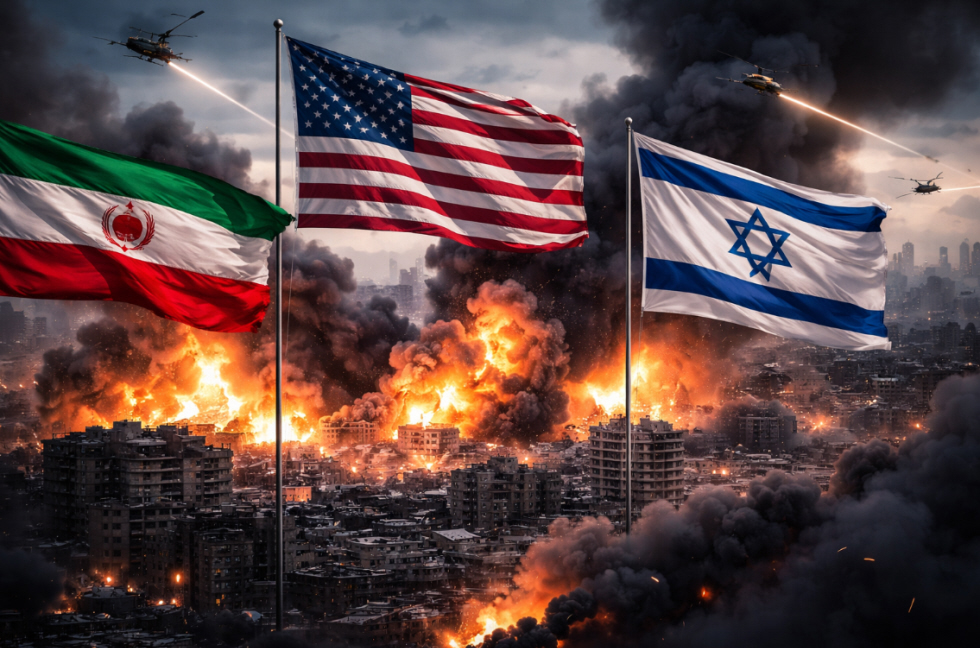
The war in the Middle East continues to expand, raising fears that the conflict could evolve into a broader regional confrontation. In recent days, tensions have intensified dramatically as military operations and retaliatory actions spread across several parts of the region. Governments and international observers are increasingly concerned that the situation could destabilize an already fragile geopolitical landscape. T
he United States and Israel have intensified coordinated strikes against strategic targets inside Iran. These operations are aimed at weakening key elements of Iran’s military and logistical infrastructure, particularly facilities linked to defense systems, communications networks, and technological capabilities. The attacks represent one of the most significant escalations in the confrontation so far.
Despite the damage inflicted during these operations, Iran’s political and religious leadership appears to remain functional. Authorities in Tehran have sought to demonstrate stability and control, rapidly reorganizing command structures and maintaining the operation of state institutions. The centralized nature of Iran’s governing system has allowed it to respond quickly to mounting pressure.
Iran has also responded with strong counteractions across the region. Various incidents involving drones, missiles, and indirect operations have been reported in different parts of the Middle East. These developments have increased fears that the conflict could expand beyond its current scope and draw additional actors into the confrontation. The economic consequences of the conflict are already being felt around the world. Global oil and gas markets have come under heavy pressure as investors worry about potential disruptions to energy supply routes.
The Persian Gulf remains one of the most critical energy corridors on the planet, making any instability in the area a major concern for global markets. Beyond the economic impact, the conflict has also begun to affect civilian infrastructure. Several facilities in urban and industrial areas across the region have reportedly suffered damage during the exchange of attacks. The deterioration of infrastructure adds further strain on local governments and increases uncertainty among civilian populations. One particularly alarming incident occurred when a drone struck near the United States consulate in Dubai.
Although the attack did not cause major damage to the diplomatic facility, it triggered heightened security alerts throughout the United Arab Emirates and neighboring Gulf states. The event suggests that the confrontation is reaching areas previously considered relatively secure. Inside Iran, political developments are also unfolding rapidly. Reports from the region indicate that a new ayatollah may have been appointed in order to reinforce the continuity of religious leadership. Such decisions are often intended to preserve institutional stability during periods of intense political and military pressure. International analysts believe the conflict has entered a critical phase.
The decisions made by the main actors in the coming days could determine whether the confrontation remains contained or escalates into a far larger regional crisis. The potential involvement of additional countries could quickly alter the strategic balance. For now, the Middle East remains in a state of heightened uncertainty.
Governments, financial markets, and international institutions are closely monitoring developments. What happens next may not only reshape the regional balance of power but could also have far-reaching consequences for global political and energy stability.


