
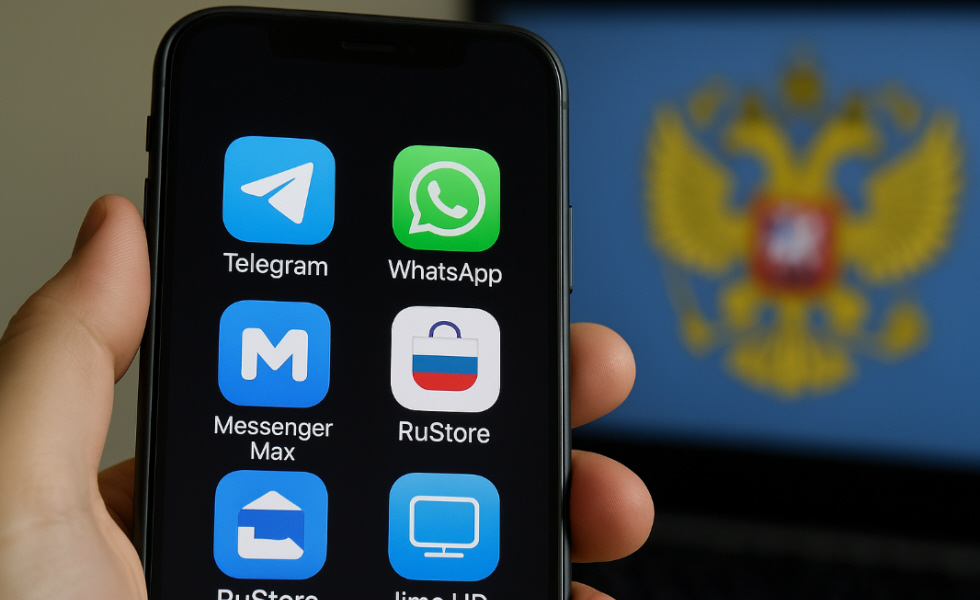
Moscow has declared war on foreign messaging platforms such as WhatsApp and Telegram: calls through both applications have been disrupted by massive interruptions for nearly two weeks. To address this, a competing application will soon be preinstalled on all mobile phones and tablets in Russia. Critics fear the Kremlin could use it for espionage. Recently, Russian authorities said that measures were being taken “to partially restrict calls through these foreign messengers.”
According to Reuters news service, voice calls on Telegram are already barely functioning, and on WhatsApp, noises such as a metallic hum have made conversations impossible. Mutual Accusations Between the Kremlin and WhatsApp Russia justified the drastic measure of restricting the services by claiming that they refused to transmit information related to terrorism to Russian authorities.
WhatsApp then stated that Moscow’s government would be denying its citizens access to secure communications. To ensure that all Russian residents use government-approved services, the authorities have gone a step further by banning WhatsApp and Telegram from smartphones. Starting in September, Messenger Max must be preinstalled on all mobile phones and tablets.
The app will also be integrated into government services. Critics fear this will make espionage easier. Russian state media attempted to dispel these concerns, claiming that Max even had fewer access rights to user data than its competitors WhatsApp and Telegram. The App Store and TV Application Also Involuntarily Added to Phones Another application that will be mandatory on all newly purchased Apple phones as of September 1 is the Russian app store RuStore.
Previously, this was only required to be preinstalled on Android devices. Starting in January, a Russian television app called LIME HD TV will also be installed, allowing users to watch state television channels for free, on all smart TVs sold in Russia. In June, the Russian parliament, the State Duma, also approved a law to create its own messenger. Government services would also be integrated into this chat program, it was said at the time.
Moscow Continues to Restrict Media Use Since the beginning of Russia’s war of aggression against Ukraine more than three years ago, Moscow has massively tightened censorship and Internet control. Now the State Duma wants to pass another law. Anyone seeking information that Russian authorities have classified as extremist will face fines in the future. This classification primarily affects those who criticize the Kremlin. Meta, the company behind Facebook, Instagram, and WhatsApp, also falls into this category.
A third reading of this law is still pending, but is considered a formality. Numerous sites, including those of Western and independent media, are already blocked in Russia. Many online services have been restricted to the point where they can hardly be used without a virtual private network (VPN). To make it even harder for Russians to access blocked content, VPN services are increasingly being blocked as well. Mobile Internet shutdowns are also becoming more common.


