
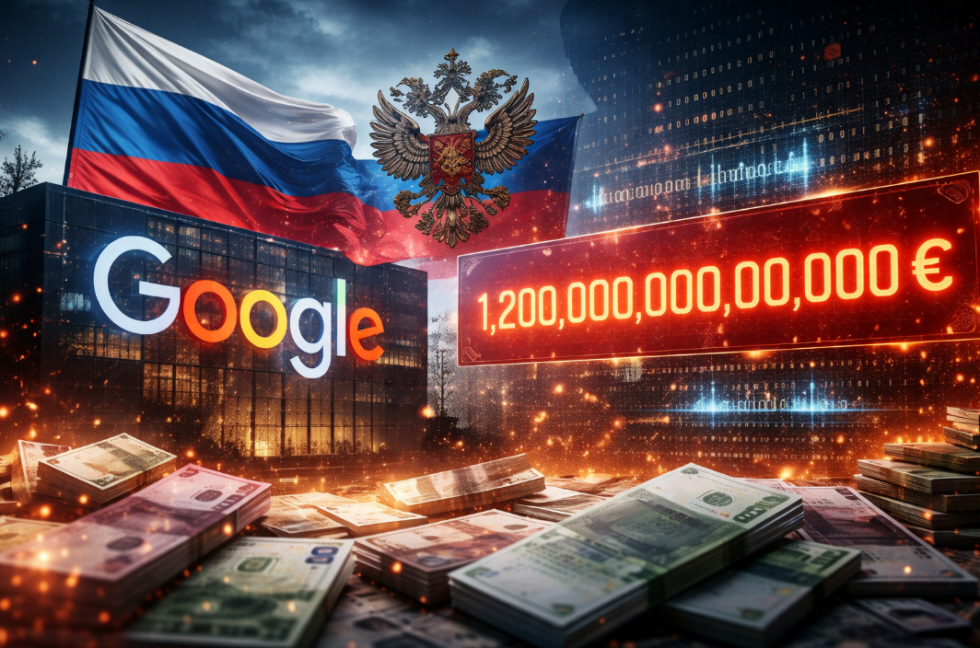
A Russian court has ordered Google to pay a fine of 1.2 quintillion euros in a case related to the blocking of Russian state media channels on YouTube. The staggering figure—1.2 followed by 18 zeros—far exceeds the market value of Google’s parent company and surpasses the gross domestic product of many national economies. The case stems from Google’s decision to restrict or remove Russian television channels after international sanctions were imposed on Moscow.
Russian authorities have accused the company of violating domestic laws and engaging in what they describe as digital censorship. The fine was not imposed as a single lump sum but grew over time through a system of daily penalties added to the original claim. This mechanism caused the total amount to escalate dramatically, transforming the case into a symbolic confrontation rather than a financially realistic demand.
Analysts note that the size of the penalty carries strong political and media messaging. In practical terms, a sum of this magnitude is impossible to enforce or collect, suggesting that the ruling is primarily intended as a statement within the broader digital standoff between Russia and Western technology platforms. The dispute reflects a wider struggle over control of information flows amid geopolitical tensions. Following the war in Ukraine and subsequent sanctions, Western tech companies limited the reach of Russian state media, prompting regulatory and legal responses from Moscow.
From Russia’s perspective, the action against Google is framed as a defense of informational sovereignty and protection of national media outlets. From the Western viewpoint, YouTube’s restrictions were presented as measures aimed at curbing the spread of state-backed propaganda. The case also highlights the growing fragmentation of the global digital landscape. While some countries advocate for open information ecosystems under international norms, others are advancing regulatory frameworks designed to exert greater control over foreign technology companies.
Economically, the fine does not pose an immediate threat to Google’s global stability, but it deepens the divide between the company and the Russian market. In recent years, several Western tech firms have reduced operations or faced mounting legal and regulatory pressure within Russia. The ruling could set a precedent for future clashes between governments and major technology corporations.
As digital infrastructure becomes increasingly central to national strategy, regulatory disputes are taking on strategic weight comparable to traditional trade conflicts. Beyond the eye-catching number, the case symbolizes the intensifying digital conflict between Russia and the West. Whether enforceable or not, the ruling serves as a political signal in an ongoing struggle over influence, information control, and technological power.


