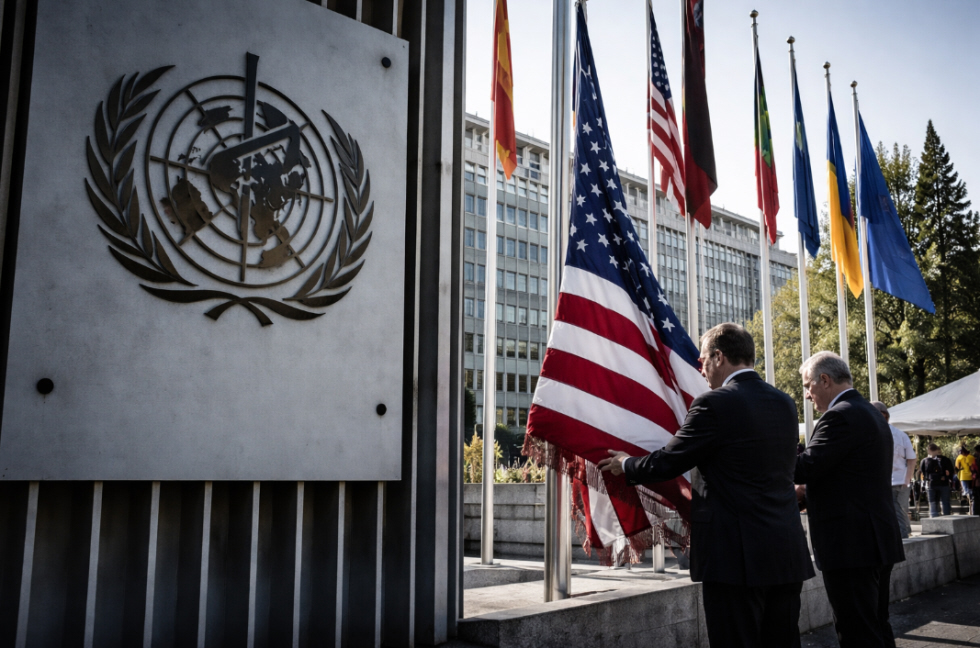
The United States has formally completed its withdrawal from the World Health Organization (WHO), ending decades of financial support and institutional participation that once positioned Washington as the organization’s primary architect and largest contributor. The decision represents a strategic rupture in global health governance and signals a broader shift in U.S. engagement with multilateral institutions. U.S. officials justified the move by arguing that the WHO has evolved into an overly politicized structure burdened by bureaucratic inertia and agendas that no longer align with the interests of its founding members.
The withdrawal includes the termination of funding, staffing, and joint programs, effectively severing all operational ties. From Washington’s perspective, the United States served as the backbone of the WHO since its inception, both financially and operationally. The exit is framed as a long-overdue correction to what U.S. leaders describe as a loss of institutional credibility and technical independence at critical moments for global health coordination. Tensions escalated symbolically when U.S. officials cited disputes even over protocol matters, interpreting them as signs of political resistance to the withdrawal.
These incidents were presented as evidence that the organization is unwilling or unable to adapt to a changing geopolitical environment that increasingly demands transparency and accountability. The debate has extended beyond Washington. In Israel, lawmakers have renewed efforts to reassess the country’s relationship with the WHO, raising concerns that the organization maintains hostile positions and could pose risks to Israel’s sovereignty, scientific innovation, and economic interests.
During the ongoing war in Gaza, hardline Israeli legislators intensified their criticism, accusing the Geneva-based agency of political bias and of overstepping its mandate under the banner of international cooperation. These arguments have reignited a longstanding debate over the limits of multilateral institutions during periods of armed conflict. The U.S. withdrawal and Israel’s internal debate reflect a broader global trend: increasing skepticism toward international organizations in a world marked by strategic rivalry and institutional fragmentation.
For some governments, these bodies are no longer viewed as neutral arbiters but as political arenas shaped by competing interests. Beyond its immediate impact, the U.S. exit raises long-term strategic questions. The WHO loses its largest historical contributor, while the international system faces the challenge of redefining global health cooperation amid shifting power balances, declining trust in institutions, and a rapidly evolving geopolitical order.

