
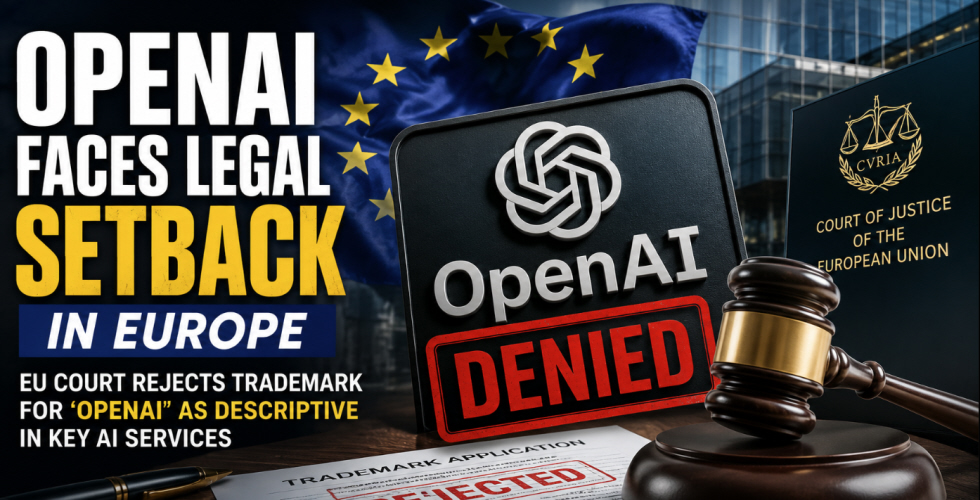
OpenAI has suffered a significant legal setback in Europe after the General Court of the European Union upheld a decision limiting the registration of the name "OPENAI" for certain software and artificial intelligence products and services. The ruling marks an important milestone in the ongoing debate over trademark protection in the rapidly expanding AI industry. According to the court, the term "OPENAI" may be understood by a substantial portion of the public as a descriptive expression referring to open artificial intelligence rather than as a distinctive commercial trademark. As a result, the designation does not qualify for full trademark protection in several specific product categories.
The judgment confirms an earlier decision issued by the European Union Intellectual Property Office, which had partially rejected OpenAI's trademark application. Regulators concluded that the wording directly describes the nature of some of the company's services instead of uniquely identifying a single commercial source. Although the ruling limits trademark registration in certain areas, it does not prevent OpenAI from continuing its operations across the European market. The company remains free to provide its AI platforms, software, and cloud-based services while considering its legal options.
Industry experts view the case as another example of the growing importance of intellectual property in the artificial intelligence sector. As competition intensifies and new technologies emerge, brand identity has become almost as valuable as the innovations themselves. The decision also highlights the European Union's strict approach to trademark law. Authorities seek to ensure that descriptive terms remain available for general use and are not monopolized by individual companies, preserving fair competition throughout the digital marketplace. For OpenAI, the case represents another chapter in its global expansion strategy.
The company continues to strengthen its international presence through strategic partnerships, enterprise solutions, and new AI products designed for businesses, developers, and consumers worldwide. The ruling may influence future trademark applications submitted by other artificial intelligence companies. Businesses entering the rapidly evolving AI market may need to choose more distinctive brand names that meet the legal standards required for trademark protection.
Despite the unfavorable outcome, OpenAI still has the opportunity to appeal the decision before the Court of Justice of the European Union. Such an appeal could potentially modify or overturn parts of the current ruling depending on the legal arguments presented. Beyond the immediate legal implications, the dispute demonstrates that the future of artificial intelligence will depend not only on technological breakthroughs but also on complex legal issues involving trademarks, intellectual property rights, and market competition. These legal frameworks are expected to play an increasingly important role as the AI industry continues to expand.

