
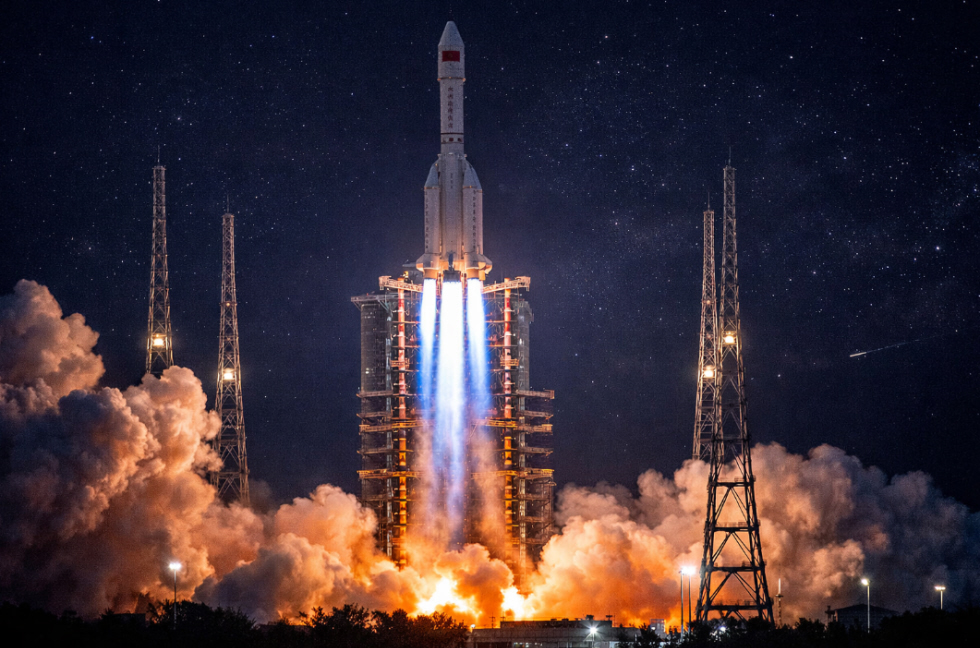
China has taken a significant step forward in its ambitious crewed lunar exploration program after successfully completing key tests of its next-generation launch vehicle and the Mengzhou spacecraft capsule. According to official information, the Long March 10 rocket conducted low-altitude test flights from the Wenchang Space Launch Center on Hainan Island.
At the same time, the Chinese space agency carried out an emergency launch abort test using the spacecraft’s return capsule, designed to protect astronauts in the event of a failure during liftoff. Such tests are critical to certifying safety standards for future human space missions. During the trial, the capsule separated from the simulated launch system and performed a controlled descent, eventually landing in the sea as planned. Recovery teams successfully retrieved the spacecraft, confirming that the system operated within expected parameters. It marked the first time China conducted a maritime recovery of a next-generation capsule specifically developed for crewed missions.
The spacecraft is designed to be reusable, representing a major technological advancement in operational efficiency and long-term sustainability. The Long March 10 rocket is expected to serve as the primary launch vehicle for transporting Chinese astronauts toward lunar orbit in upcoming missions. Its development is part of a broader national strategy aimed at strengthening China’s capabilities in deep-space exploration. Beijing has reiterated its goal of completing a crewed lunar landing before 2030.
Beyond the initial mission, China envisions the gradual construction of a scientific base on the Moon, potentially in cooperation with international partners. In the context of the renewed global space race—where the United States is advancing its Artemis program—each successful technical milestone carries strategic significance. Demonstrating reliable launch and safety systems enhances both national prestige and geopolitical influence.
With these tests, China claims to have achieved an important breakthrough in its crewed lunar program. The coming decade could mark a sustained human return to the Moon, this time within a multipolar and highly competitive space environment.

