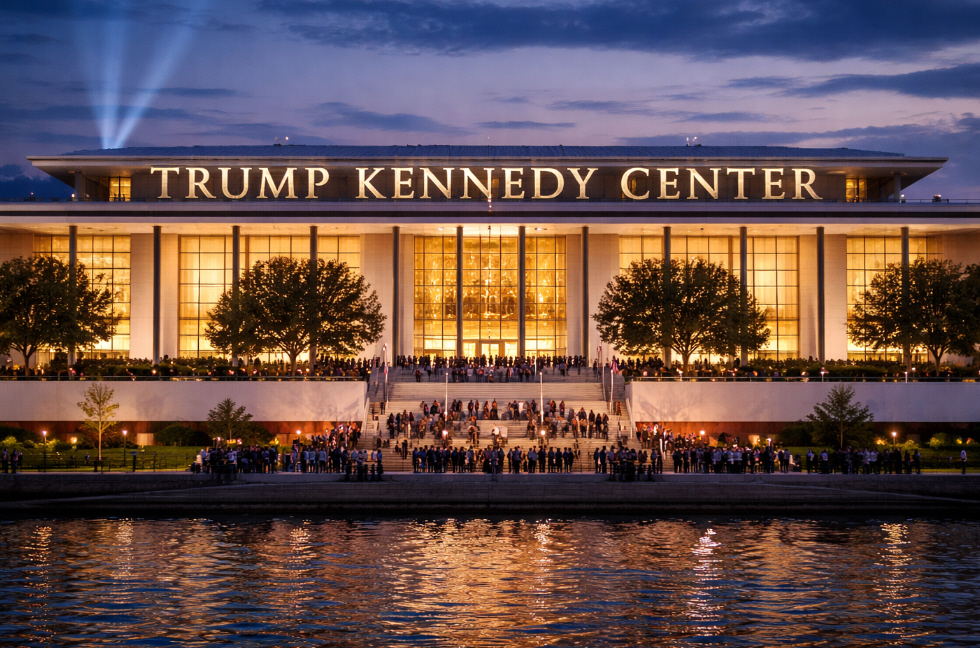
President Donald Trump announced through his Truth Social platform an ambitious renovation plan for the cultural complex located along the Potomac River, now officially named the Trump Kennedy Center. According to his statement, the goal is to transform the venue into “the best place for music, art, and entertainment in the world” through a comprehensive modernization of its facilities.
The announcement comes amid repeated acknowledgments by the U.S. government that the cultural complex has suffered from significant deterioration. Authorities had warned that several parts of the building faced structural and technological issues, making an extensive renovation necessary to ensure its long-term viability. The Kennedy Center was originally named in honor of former President John F. Kennedy and has for decades stood as one of the country’s most prominent cultural institutions.
It has traditionally hosted theater, dance, and music productions of all genres, becoming a symbol of institutional support for the arts in the United States. The addition of Trump’s name to the cultural center was formally approved in December and immediately sparked controversy both domestically and internationally. Critics argued that the decision politicizes an institution historically associated with culture rather than with any single political figure. As a result of the announcement, several artists and international ensembles chose to cancel previously scheduled performances.
These cancellations were widely interpreted as symbolic protests against the name change and the broader debate surrounding the center’s role as a politically neutral cultural space. From Trump’s inner circle, the move has been defended as an effort to revitalize the complex and reposition it on a global level. Supporters argue that the renovation will attract new productions, expand artistic offerings, and enhance the overall audience experience. The controversy has also reignited a broader discussion about the relationship between politics and culture in the United States.
For some, the change represents a redefinition of the institution’s meaning; for others, it is viewed as an administrative decision tied to funding and management priorities. As further details regarding the scope and timeline of the renovation are awaited, the future of the Trump Kennedy Center remains shaped by a mix of cultural expectations and political debate. The ultimate impact of the project will depend not only on its artistic outcomes, but also on the institution’s ability to rebuild consensus in an increasingly polarized social climate.