
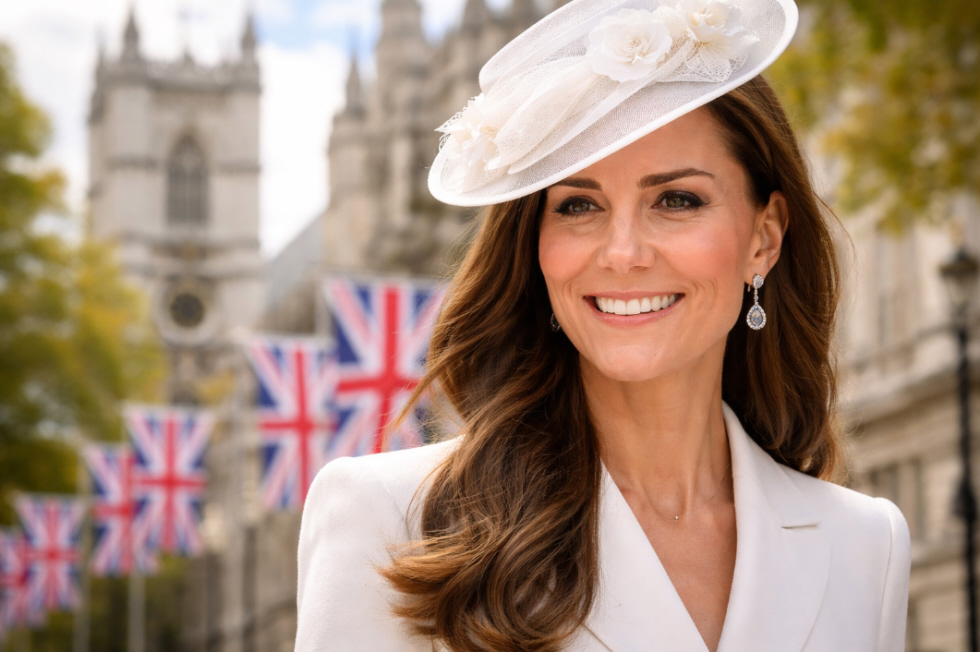
In a monarchy long defined by lineage, privilege, and inherited titles, it is striking that the most popular member of Britain’s royal family is someone born outside that world. Princess Kate, born Catherine Middleton, has become the best-liked figure within the monarchy, surpassing even her husband, Prince William, the heir to the throne. According to the latest popularity ranking by polling institute YouGov, more than two-thirds of the British public—68 percent—hold a positive view of Kate, who turns 44 on January 9. Her standing at the top of the list highlights not only her personal appeal but also a broader shift in how the monarchy is perceived.
Prince William, 43, now trails his wife with a 62 percent approval rating. He is followed by Princess Anne, 75, with 59 percent, while King Charles III is viewed positively by just over half of the population, at 54 percent. At the bottom of the rankings stands Prince Andrew, whose reputation has been deeply damaged by scandal, with only 13 percent approval. Kate’s influence extends well beyond opinion polls. Her growing prominence within the royal family has also been reflected in symbolic gestures. During the state visit of U.S. President Donald Trump in September, it was Kate—not Queen Camilla—who was seated to the right of the visiting head of state, a powerful signal of her elevated status.
What explains this sustained popularity? While her athletic appearance, elegance, and sense of fashion are often noted, experts argue that these qualities alone do not tell the full story. Craig Prescott, a constitutional law expert and royal commentator at Royal Holloway University of London, believes her background plays a crucial role. Born into a middle-class family, Kate did not inherit her place within the monarchy but adapted to it. This has allowed her to maintain a sense of relatability that is rare in royal institutions.
Prescott recalls her visit to a spontaneous memorial at London’s Clapham Common following the 2021 abduction and murder of Sarah Everard. During that visit, Kate spoke openly about her own fears of walking alone at night in London. According to Prescott, such remarks bring “a sense of normality” to an institution that many perceive as distant and unusual. Kate, he argues, humanizes the monarchy without undermining it. Her approach also contrasts sharply with that of Meghan Markle, the wife of Prince Harry, whose departure from royal life and return to celebrity culture has made her a far more polarizing figure in Britain.
YouGov data shows that only around a quarter of the British public view Meghan positively. Kate’s reputation has been further strengthened by her strong sense of duty and long-term commitment to charitable work. This image of stability and responsibility became even more pronounced in early 2024, when she underwent abdominal surgery and spent nearly two weeks in hospital. While still recovering, the Princess of Wales was diagnosed with cancer and subsequently began chemotherapy, which she has since successfully completed.
Although the specific type of cancer was never disclosed, Kate chose an unusually open approach to communication. In a series of video messages, she spoke candidly about her illness and its impact on her family. “The past nine months have been incredibly tough for us as a family,” she said when announcing the end of her treatment, noting that life can change “in a single moment.” Looking ahead, Prescott believes Kate is likely to play a far more prominent role than previous royal consorts.
If William and Catherine become king and queen, the monarchy could be perceived as more of a joint partnership, at least in the eyes of the public. That leadership is already visible in initiatives such as Kate’s annual Christmas carol service at Westminster Abbey, held in honor of volunteers. The event has gained such prominence that it now rivals the King’s traditional Christmas address, reinforcing Kate’s position not only as the most popular royal, but also as one of the institution’s most influential figures.


