
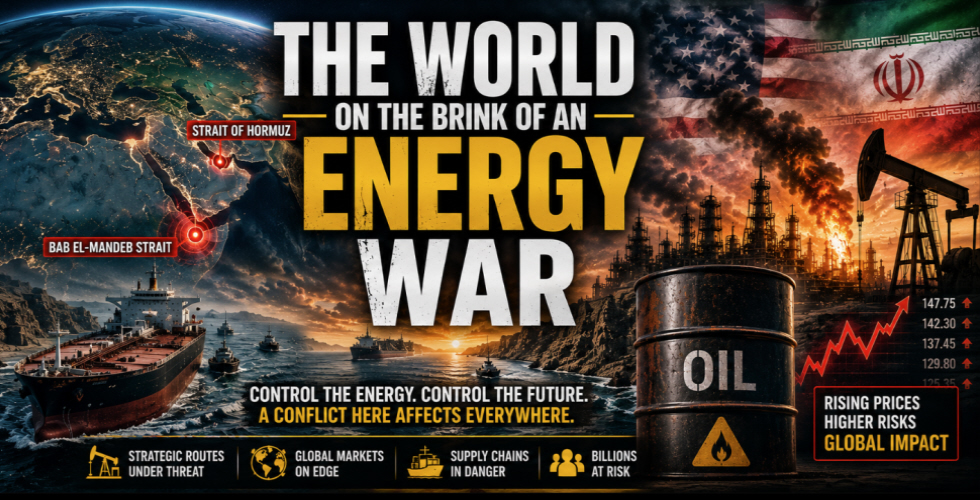
For decades, many believed that oil would gradually lose its role as the driving force behind major international conflicts. Recent events, however, suggest the opposite. The routes through which global energy supplies move remain at the very heart of the world economy, and any threat against them immediately affects millions of people. Today, geopolitics is once again revolving around strategic maritime chokepoints and those capable of controlling them. The Strait of Hormuz and the Bab el-Mandeb Strait are far more than ordinary shipping lanes. They serve as essential arteries through which a significant portion of the world's oil and international trade flows every day.
If either route becomes unstable or inaccessible, the effects quickly spread across financial markets, manufacturing industries, supply chains, and consumers on every continent. History has repeatedly shown that modern wars do not always begin with massive ground invasions. In many cases, disrupting the flow of strategic resources is enough to inflict enormous economic damage. Control over energy has become as powerful a geopolitical weapon as military force, allowing nations and regional actors to influence governments and markets without occupying foreign territory.
The growing rivalry between the United States and Iran perfectly reflects this evolving reality. Diplomatic disagreements are increasingly accompanied by warnings involving critical infrastructure, maritime security, and global energy supplies. Every new threat raises uncertainty and increases the possibility that a single incident could escalate into a much broader confrontation. At the same time, regional groups such as the Houthis have demonstrated that even non-state actors with limited resources can influence the global balance of power.
Threatening or disrupting strategic shipping routes creates economic consequences far greater than the military capabilities required to carry out such actions. Local conflicts can therefore evolve into international crises within a matter of days. Financial markets react almost instantly whenever concerns arise about the security of global energy supplies. Rising uncertainty typically drives oil prices higher, increasing transportation costs, industrial production expenses, and the prices of countless consumer goods. What begins as a regional dispute eventually reaches households and businesses across the globe through higher inflation and economic pressure.
Ironically, while the world continues investing in renewable energy, oil remains a decisive factor in many strategic calculations. The energy transition is progressing, but fossil fuels still dominate sectors such as maritime transportation, aviation, and heavy industry. As a result, the geopolitical importance of the Middle East remains as significant today as it has been for decades. Diplomacy now faces one of its most difficult challenges in recent history. Every public threat reduces the space available for negotiation while increasing the risk of dangerous miscalculations.
In a region involving multiple governments, armed groups, and competing alliances, even a relatively small incident could rapidly expand beyond its original borders. The greatest danger does not lie solely in the possibility of direct military conflict between two nations. An even greater concern is that multiple crises occurring simultaneously could disrupt global supply chains, undermine financial stability, and slow economic growth worldwide.
In today's interconnected economy, no country remains isolated from a major energy crisis. The international community faces the urgent challenge of ensuring that competition over strategic energy routes does not permanently replace political dialogue. Protecting vital maritime corridors will be just as important as preserving diplomatic communication among the world's leading powers. The future stability of the global economy may ultimately depend on preventing energy from becoming the spark that ignites the next major international conflict.
By:
Williams Valverde

