
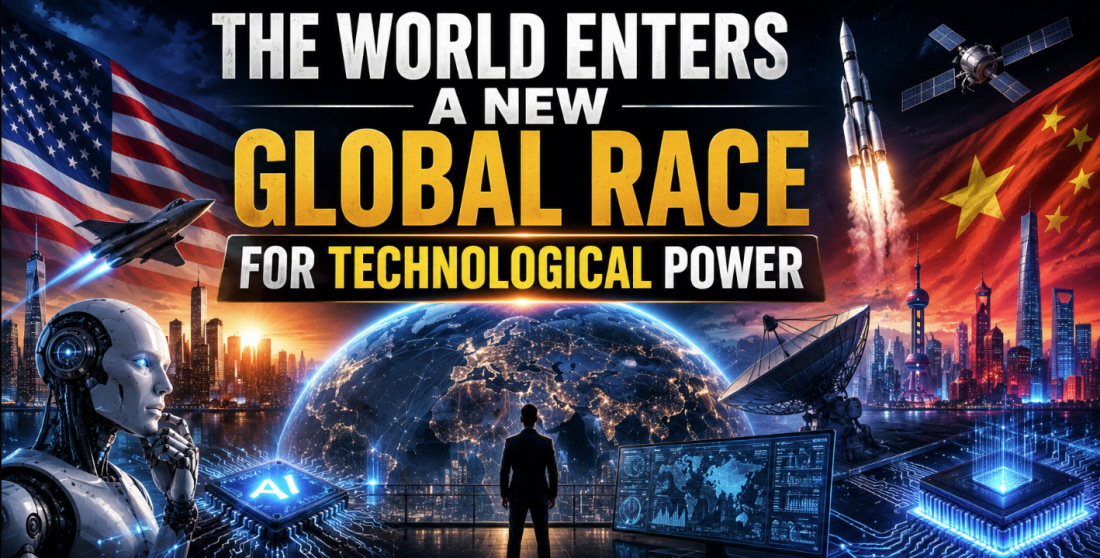
History has shown that every major transformation of civilization has been driven by technological innovation. From the Industrial Revolution to the rise of the Internet, the nations that mastered new technologies also strengthened their political, economic, and military influence. Today, the world is entering another defining era in which technology has become the most valuable strategic asset. Unlike the great rivalries of the past, this new competition is no longer measured solely by military strength or natural resources.
The true advantage now lies in the ability to develop artificial intelligence, manufacture advanced semiconductors, manage vast amounts of data, and secure critical digital infrastructure. Artificial intelligence stands at the center of this global transformation. Governments, universities, and private companies are investing billions of dollars to create systems capable of automating complex tasks, analyzing enormous datasets, and supporting critical decision-making. Leadership in AI will likely shape the balance of economic and geopolitical power for decades. Semiconductors have become the strategic resource of the twenty-first century.
Every smartphone, computer, electric vehicle, satellite, medical device, and advanced defense system depends on increasingly sophisticated microchips. As demand continues to grow, control over chip production has become a matter of national security. At the same time, quantum computing is emerging as the next technological frontier. Although still in its early stages, it promises computing capabilities far beyond those of today's most powerful systems. Its potential applications range from scientific research and medicine to logistics, cybersecurity, and financial modeling. The competition also extends beyond Earth.
Satellites now play an essential role in communications, navigation, weather forecasting, intelligence gathering, and global commerce. Countries that expand their presence in space will strengthen their strategic capabilities and improve their resilience in an increasingly interconnected world. Cybersecurity has become another critical battlefield in this technological race. Digital attacks can disrupt hospitals, financial institutions, energy grids, transportation systems, and government networks. Protecting sensitive information and critical infrastructure is now considered a national priority by governments around the globe.
However, rapid technological progress also raises important ethical questions. The responsible use of artificial intelligence, the protection of personal privacy, and the regulation of data collection will require thoughtful policies and international cooperation to ensure that innovation benefits society while safeguarding fundamental rights. The global workforce will also experience profound changes. Many repetitive tasks will become automated, while new careers in software development, robotics, artificial intelligence, cybersecurity, and data science will continue to expand.
Education systems must evolve to prepare future generations for this changing reality. Businesses that embrace innovation will be better positioned to compete in tomorrow's economy. Investing in research, digital transformation, and emerging technologies will no longer be optional but essential for long-term growth and survival in an increasingly competitive global marketplace. Even amid intense competition, international cooperation will remain indispensable.
Scientific collaboration, common technological standards, and agreements on responsible innovation can help maximize the benefits of technological progress while reducing unnecessary tensions between major world powers.
The global race for technological leadership has only just begun, and its outcome will shape the future of economies, national security, and everyday life. More than a contest to build faster machines, it is a struggle to define who will lead the next chapter of human progress and how the technologies of tomorrow will influence the world for generations to come.

