
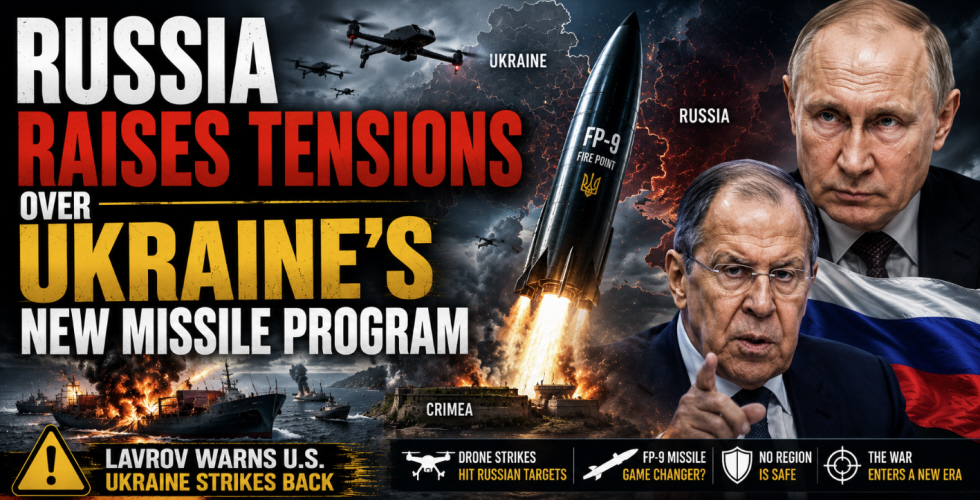
Tensions between Russia and Ukraine continue to escalate as the conflict enters a new phase defined by technological advances and the development of longer-range weapons. As fighting intensifies across multiple fronts, diplomatic warnings and military demonstrations reflect an increasingly complex and unpredictable security environment. From Moscow, Russian Foreign Minister Sergey Lavrov renewed criticism of continued Western military assistance to Ukraine. Russian officials argue that the steady flow of weapons prolongs the conflict and increases the risk of a broader confrontation in a region already facing significant instability.
At the same time, Ukraine continues to rely on drones and precision-strike systems to target military infrastructure and strategic positions. Operations around Crimea have placed growing pressure on Russian forces, forcing them to strengthen air defenses and expand security measures throughout the Black Sea region. Recent attacks against vessels and logistics facilities connected to Russian military operations demonstrate how modern technology has become a defining element of the war. Every new operation pushes both sides to adapt their tactics and invest in increasingly sophisticated defensive capabilities.
Against this backdrop, the Ukrainian defense company Fire Point unveiled its FP-9 ballistic missile project earlier this year. Although questions remain about when the system could become fully operational, its announcement has attracted considerable attention among military analysts and defense specialists. The FP-9 has been described as a significant step forward compared to earlier systems developed by Ukraine. Potential improvements in range, precision, and strike capability have fueled debate about how such technology could influence the strategic balance if deployed on a wider scale.
Many analysts believe the emergence of next-generation weapons forces Russia to reassess its territorial defense strategy. The possibility that more distant military and logistical targets could become vulnerable has increased concerns about protecting critical infrastructure throughout the country. Meanwhile, the international community continues to closely monitor developments.
Every announcement involving new military capabilities adds to the uncertainty surrounding the conflict's future and raises questions about how major global powers may respond to changing battlefield conditions. Diplomatic efforts remain largely stalled as both nations continue strengthening their military positions. In this environment, technological innovation has become one of the most influential factors shaping operational effectiveness and the overall direction of the war.
As the conflict evolves, both Russia and Ukraine continue adapting to rapidly changing military realities. The combination of advanced weapon systems, precision operations, and sustained diplomatic pressure has created an environment where every technological breakthrough could significantly influence the course of the war.


