
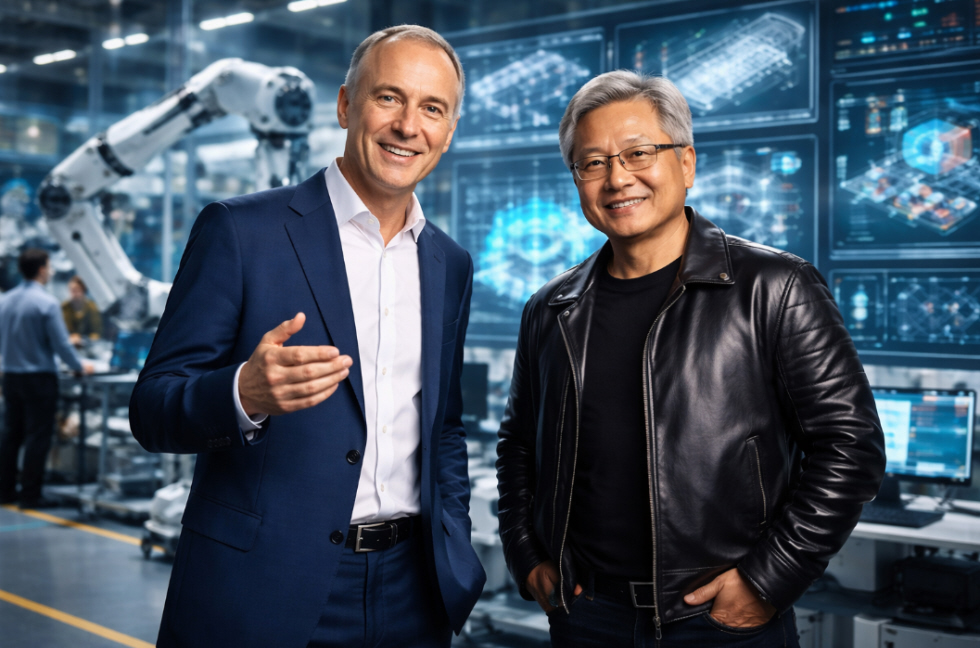
German industrial group Siemens and U.S. chipmaker Nvidia have announced a major expansion of their cooperation in the field of artificial intelligence, aiming to fundamentally reshape industrial production. The announcement was made during the CES technology fair in Las Vegas and highlights both companies’ intention to push AI beyond digital environments into real-world industrial applications. The CEOs of both companies, Roland Busch of Siemens and Jensen Huang of Nvidia, emphasized that the industrial sector is entering a new phase of transformation.
According to them, artificial intelligence is set to become a core driver of the next industrial revolution, deeply embedded in how products are designed, planned, and manufactured. A central element of the expanded partnership is the development of a new tool called Digital Twin Composer, designed to create highly accurate digital replicas of factories and industrial products. These digital twins allow companies to simulate entire production facilities in real time and test changes long before any physical infrastructure is built. Through these simulations, engineers can virtually train robots, optimize workflows, and identify potential issues without disrupting real operations.
This approach is intended to reduce costs, shorten development cycles, and improve overall efficiency across industrial processes. Siemens and Nvidia also outlined plans to jointly build what they described as an industrial AI operating system. In this framework, Siemens contributes its expertise in industrial processes, automation hardware, and specialized software, while Nvidia provides AI infrastructure, computing power, and advanced simulation platforms. Roland Busch explained that the new tools go beyond traditional modeling.
Artificial intelligence is not only able to analyze existing data, but also to generate concrete design recommendations, such as optimizing vehicle aerodynamics or improving complex industrial components before they reach the production stage. Another key focus of the partnership is the integration of AI into human-centered work environments. Siemens continues to develop solutions that combine artificial intelligence with smart devices, including augmented reality glasses that deliver AI-supported instructions to workers directly through visual or audio guidance. With this strategy, Siemens is positioning itself more clearly as a technology partner for industrial AI and digital production.
The company is increasingly moving away from its traditional image as a machinery manufacturer toward a role as a provider of integrated, AI-driven industrial solutions. Alongside this cooperation, additional AI-focused initiatives were presented at CES, including projects aimed at building large-scale AI production infrastructures designed to accelerate the development and deployment of advanced AI applications for businesses.
Together, these developments reflect a broader shift toward the convergence of artificial intelligence, advanced simulation, and physical industrial systems. For Siemens and Nvidia, the expanded partnership is intended to lay the groundwork for smarter, more flexible, and more efficient factories capable of meeting the demands of future industrial production.


