
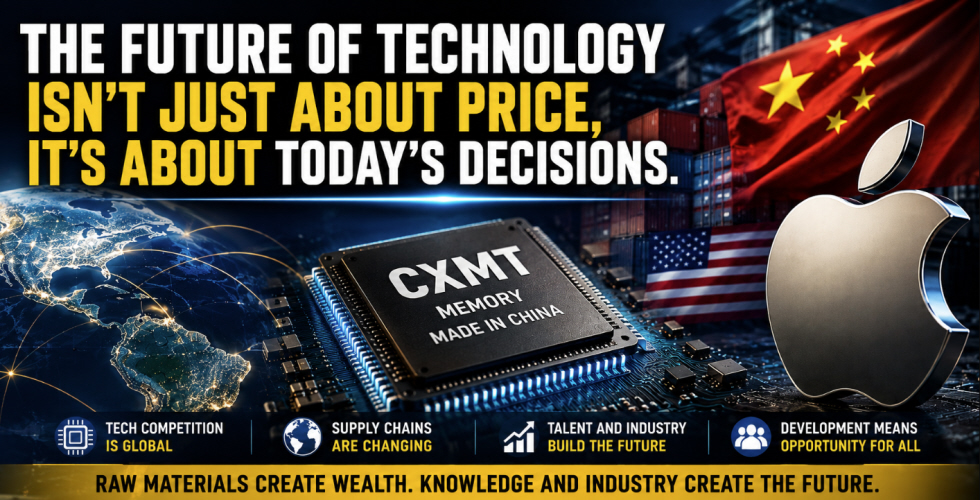
Apple is evaluating memory chips manufactured by Chinese company CXMT to determine whether they could eventually be incorporated into certain iPhone and MacBook product lines. The possibility emerges as technology manufacturers face higher memory costs and increasing competition for production capacity. The expansion of artificial intelligence is absorbing enormous semiconductor industry resources and changing the priorities of major manufacturers. For Apple, finding additional suppliers represents a way to protect costs, supply availability and negotiating power. The tests do not mean Apple has decided to commercially use CXMT memory or that it intends to immediately replace its traditional suppliers.
The company must verify quality, performance, reliability, availability and the ability to manufacture millions of components under extremely demanding specifications. Samsung, SK Hynix and Micron continue to occupy fundamental positions within the global memory market. Eventually incorporating another supplier could allow Apple to diversify risks and reduce its dependence on a relatively small number of manufacturers. The possibility of using Chinese components also introduces a political dimension extending far beyond the price of a memory chip.
The United States is attempting to reduce certain technological dependencies on China while American companies need competitive supply chains to maintain prices and margins. Apple therefore faces two requirements that do not always move in the same direction: geographically diversifying production while securing sufficient components at competitive costs. That contradiction reflects one of the greatest challenges currently confronting the global technology economy. India naturally emerges as a possible alternative because Apple has already transferred a growing portion of its device manufacturing there.
However, assembling phones and computers does not automatically mean possessing an industry capable of producing advanced DRAM in enormous quantities. India is rapidly building its semiconductor ecosystem through new investments, assembly operations, testing facilities and manufacturing projects. The challenge will be transforming those initial capabilities into a supply chain large and sophisticated enough to compete directly with the major Asian producers. Canada presents another interesting situation because it possesses technological expertise, advanced infrastructure, abundant energy in certain regions and close economic integration with the United States.
However, it also does not currently have a major domestic DRAM manufacturer capable of immediately providing the enormous volumes required by a company such as Apple. Building that capacity requires years of investment, extremely expensive machinery and an extensive network of specialized suppliers. Favorable geography alone cannot replace decades of accumulated industrial experience. South America introduces a third long-term possibility that rarely appears in this technological discussion.
Bolivia, Chile and Argentina possess important mineral resources, while Brazil has an enormous industrial base and a considerable domestic market. The region also has professionals, universities, productive infrastructure and labor costs that can be competitive compared with more developed economies. The challenge is not imagining that a mine can immediately become a semiconductor factory, but progressively modernizing the industries that already exist. Proximity to raw materials can become an advantage when it forms part of a much broader production chain.
Copper extracted from a mine must undergo refining and transformation before reaching the extraordinary purity levels demanded by advanced electronics. The same applies to chemicals, industrial gases and numerous other materials used throughout semiconductor manufacturing. South America could capture considerably greater economic value if an increasing proportion of those resources were processed, refined and industrially transformed before leaving the region. Modernizing the productive system would therefore represent the real starting point before attempting to compete directly in the world’s most advanced chips.
Existing factories can be automated, chemical plants can raise their standards, electrical grids can be strengthened and universities can expand specialized programs in electronics, robotics, materials science and automation. The region does not need to begin from zero because it already possesses roads, industries, educational institutions and millions of trained workers. It needs to transform that existing structure to meet the demands of a much more sophisticated technological economy. That transformation also cannot succeed by leaving behind those who remain outside the opportunities offered by the modern economy.
Industrial development must be accompanied by literacy programs where still necessary, technical training, better wages and mechanisms capable of progressively incorporating rural communities and vulnerable sectors. A modern economy needs engineers and scientists, but it also requires operators, electricians, technicians, transportation workers, maintenance specialists and employees with many different levels of training. Productive modernization and social integration should therefore become parts of the same development strategy.
Apple’s testing of Chinese memory chips ultimately reveals an issue far larger than the selection of a supplier for future devices. The world is reorganizing the supply chains that will determine where the essential components of the next technological generation are manufactured. China already possesses enormous capacity, India is attempting to build an alternative and North America is seeking to recover strategic production, while South America retains resources and talent that could acquire far greater value through deep industrial modernization.
The real competition of the future will not simply be over who possesses the raw materials, but who can transform them through knowledge, industry, technology and well-paid work.

