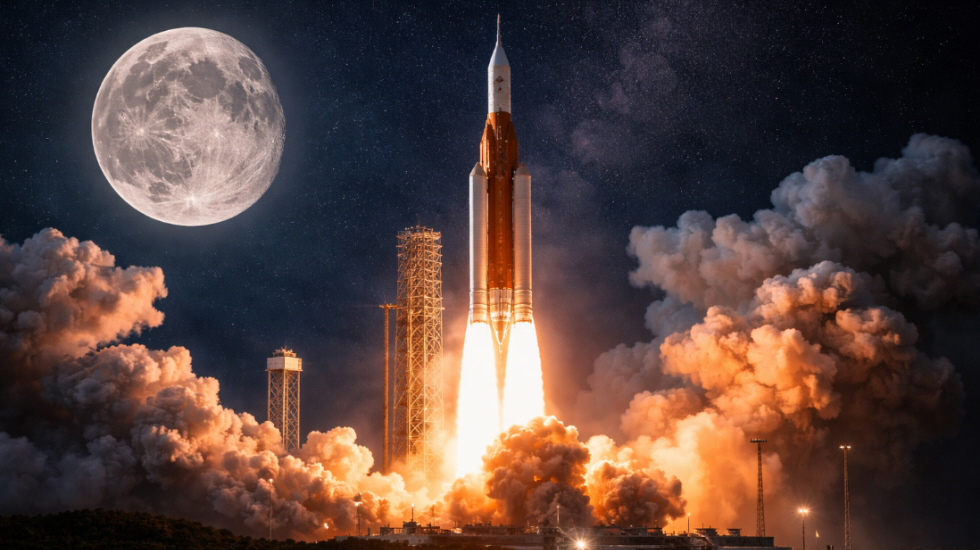
NASA is preparing for a historic moment as its Artemis II mission moves closer to launch, marking humanity’s return to lunar orbit for the first time in more than half a century. The mission represents a major milestone in modern space exploration. It reconnects the present with the legacy of the Apollo era. At the same time, it opens the door to a new chapter beyond Earth. The Artemis II mission will carry four astronauts aboard the Orion spacecraft, launched by NASA’s powerful Space Launch System rocket.
The crew will travel around the Moon without landing, testing systems critical for future missions. This step is essential before attempting a human return to the lunar surface. It serves as a bridge between past achievements and future ambitions. Unlike the Apollo missions, Artemis is designed with a broader vision in mind. NASA aims not only to revisit the Moon but to establish a sustainable human presence. The program also lays the groundwork for deeper space exploration.
Mars remains a long-term objective in this expanding strategy. The mission reflects years of technological development and international collaboration. NASA has worked to integrate advanced systems capable of supporting long-duration spaceflight. These innovations are crucial for ensuring astronaut safety and mission success. Each component has been tested to withstand the challenges of deep space. There is also a symbolic dimension to Artemis II.
The mission represents a renewed commitment to exploration and discovery. It captures the imagination of a new generation inspired by science and innovation. For many, it is a reminder that humanity continues to push beyond its limits. The return to lunar orbit carries strategic importance as well. Space is increasingly seen as a domain of global competition and cooperation. NASA’s mission reinforces its leadership in space exploration. It also signals a broader effort to shape the future of space activity.
The astronauts aboard Artemis II will play a critical role in testing navigation, communication, and life-support systems. Their journey will provide valuable data for future missions. Every phase of the mission is designed to reduce uncertainty. This preparation is essential for long-term exploration goals. Public interest in the mission has grown steadily as the launch approaches. The combination of history, technology, and human achievement creates a powerful narrative.
Millions are expected to follow the mission closely. It represents a rare moment of global attention on science. The success of Artemis II could redefine expectations for what comes next.
A return to the Moon is no longer just a symbolic goal. It is part of a larger vision for sustained exploration. The mission will help determine how quickly that vision can become reality. As the countdown begins, NASA stands at the threshold of a new era. Artemis II is more than a mission — it is a statement of intent. Humanity is once again looking toward the Moon. And this time, the journey is only just beginning.