
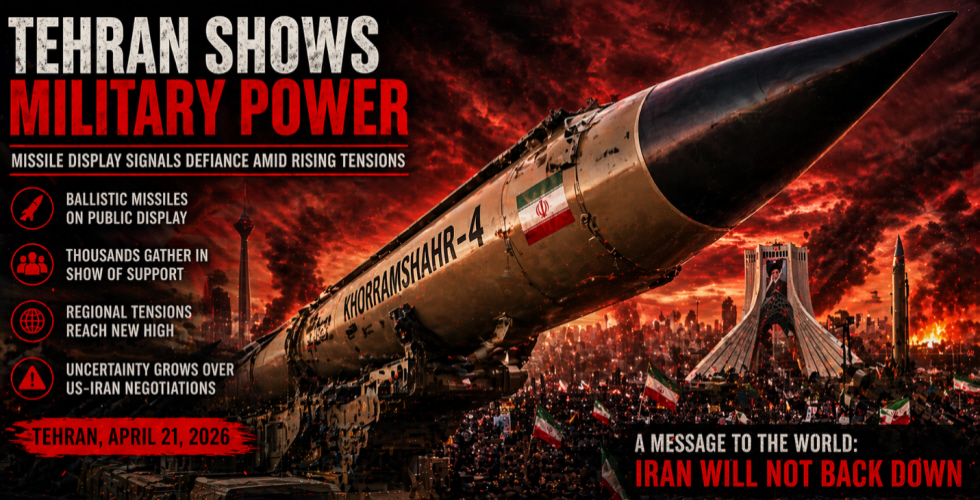
Tehran became the center of a powerful political and military display as thousands gathered in public rallies amid rising regional tensions. Demonstrations reflected a mix of support, defiance and strategic messaging directed at the international community. The atmosphere combined patriotic symbolism with visible elements of military strength. The message was clear: Iran is projecting resilience under pressure. During these rallies, ballistic missiles were displayed prominently, reinforcing the country’s defensive posture.
The presence of such systems in public spaces marked a deliberate show of force. While specific models were not officially confirmed, the visual impact was unmistakable. It served as a reminder of Iran’s expanding military capabilities. The demonstrations took place in key areas of Tehran, including symbolic urban centers known for political gatherings. These locations have historically been used to send strong internal and external signals. The scale of participation suggested coordinated organization and state-backed messaging. The streets became both a stage and a statement.
The timing of the display is particularly significant as tensions with the United States continue to evolve. With diplomatic efforts still uncertain, military symbolism has taken on a larger role. Public demonstrations now serve as extensions of strategic communication. Each visual element carries geopolitical weight. Iran’s leadership appears to be balancing two parallel strategies: signaling openness to negotiations while maintaining a posture of strength. This dual approach is designed to preserve leverage in any potential dialogue. It also reassures domestic audiences during a period of uncertainty. The message is both outward and inward.
For Washington and its allies, these developments are being closely monitored. The public display of military assets raises concerns about escalation risks. At the same time, it highlights the complexity of engaging diplomatically with Tehran. Military signaling and negotiation efforts are unfolding simultaneously. Global markets are also reacting to the evolving situation.
The intersection of military tension and energy security continues to drive volatility. Investors are watching for any signs of escalation or de-escalation. The situation remains fluid and highly sensitive to developments on the ground. As events continue to unfold, Tehran’s streets have become a reflection of a broader geopolitical struggle.
The combination of public mobilization and military imagery underscores the seriousness of the moment. Whether this leads to renewed negotiations or deeper confrontation remains uncertain. What is clear is that the stakes are growing by the day.


