
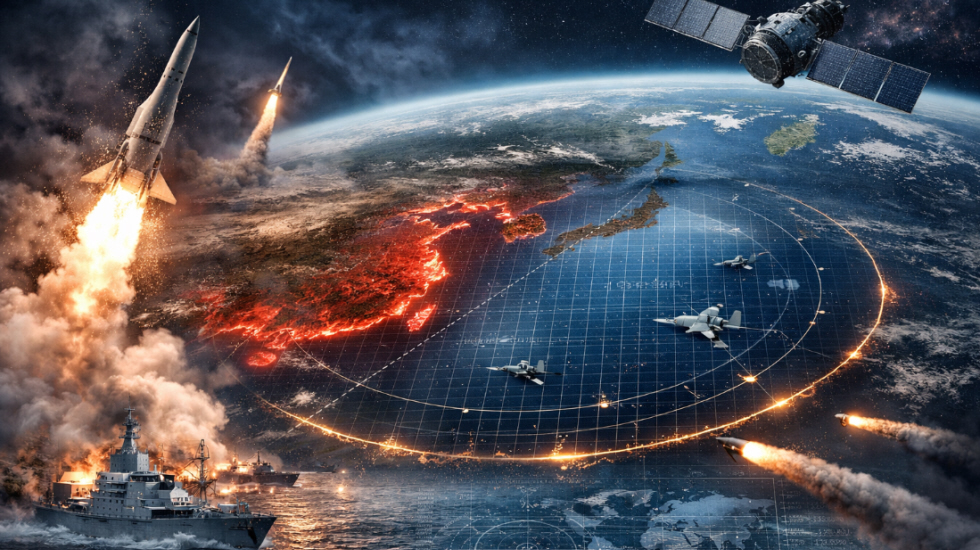
China has raised international concern after reserving a vast stretch of offshore airspace in the Pacific for 40 days without providing a clear explanation. The measure, effective from March 27 through May 6, was communicated through formal aviation notices. However, no military exercises have been announced to justify the restriction. This has increased uncertainty across the region. The affected area extends roughly 1,000 kilometers from China’s mainland into the Pacific Ocean.
The restriction also covers altitudes from the surface to unlimited levels. This scope makes the move highly unusual, even by military standards. The scale of the closure has drawn global attention. Chinese authorities have remained silent regarding the exact purpose of this decision. The lack of official information has fueled speculation among analysts and governments alike. In sensitive geopolitical contexts, silence can carry its own message.
Uncertainty becomes a strategic factor. Defense experts suggest that such restrictions could be linked to advanced military testing. Possible scenarios include missile trials or strategic technology demonstrations. These activities typically require large exclusion zones for safety reasons. Without confirmation, questions continue to grow. The move is also being closely monitored by regional military forces. Neighboring countries are watching for any development that could shift the strategic balance. The Pacific has become a key theater of global competition. Every action is analyzed in detail. Commercial aviation is also affected by decisions of this magnitude.
Airlines must reroute flights to avoid restricted zones, increasing operational complexity. This can lead to higher costs and logistical challenges. Air safety remains a top priority. Analysts point out that using NOTAMs to restrict such a large area without clear explanation is uncommon. Typically, such notices are tied to defined and transparent activities. In this case, the lack of context heightens concern. The move is widely seen as unusual.
The decision comes at a time of heightened geopolitical tension in the Indo-Pacific region. Relations between major powers remain fragile and complex. Any action of this nature can be interpreted as a strategic signal. The region continues to be a focal point of global balance. Some experts believe the restriction could be part of a demonstration of technological or military capability. These actions are often designed to send messages without direct confrontation.
Control over airspace is also a projection of strategic power. Ambiguity itself can be intentional. Looking ahead, the international community will continue to monitor developments closely. The lack of transparency leaves multiple interpretations open. Decisions made in the coming weeks could be critical. The Pacific once again stands at the center of global attention.


