
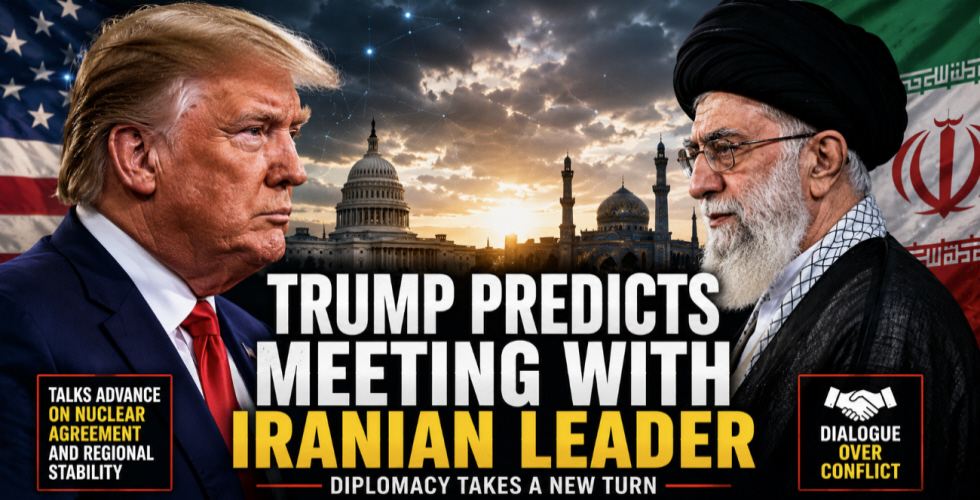
The possibility of renewed diplomatic engagement between the United States and Iran has drawn international attention following recent remarks by President Donald Trump. The president stated that significant progress has been made in discussions concerning Iran’s nuclear program. His comments have fueled expectations that tensions in the Middle East could be reduced through negotiations. Analysts believe any breakthrough could have major implications for regional stability. Trump indicated that he would be willing to meet with Iran’s supreme leader if negotiations continue moving in a positive direction.
The prospect of a high-level meeting represents a notable shift from years of confrontation and mistrust between the two nations. While no official date or agenda has been announced, the proposal has generated considerable interest among diplomats and policymakers. Observers are closely watching for further developments. One of the central issues in the discussions remains Iran’s nuclear program. According to the president’s remarks, Iran has shown a willingness to move away from any path that could lead to the development of nuclear weapons. This issue has been one of the most significant sources of tension between Washington and Tehran for decades.
Its resolution is widely viewed as essential for achieving a lasting agreement. Concerns surrounding Iran’s nuclear activities have influenced regional and international politics for many years. Numerous governments have expressed fears about the possibility of a nuclear arms race in the Middle East. At the same time, many world leaders believe diplomacy remains the most effective alternative to military confrontation. Achieving a balance between security concerns and diplomatic solutions remains a key objective.
The current diplomatic efforts are taking place amid a particularly complex regional environment. Recent months have seen episodes of violence, indirect confrontations, and growing political uncertainty across the Middle East. These conditions have complicated attempts to build trust between the parties involved. Nevertheless, ongoing discussions suggest that opportunities for dialogue still exist. International relations experts argue that a meeting between leaders of the two countries would carry significant symbolic value. Beyond any specific agreements that might be reached, such an encounter would signal a willingness to engage through diplomacy.
It could also help reduce perceptions of risk in a region often associated with instability and conflict. The political impact of such a meeting would likely be felt worldwide. In Washington, the president’s comments have been viewed as part of a broader strategy aimed at exploring new diplomatic opportunities. The administration has repeatedly emphasized its preference for negotiated solutions to longstanding disputes. At the same time, U.S. officials continue to monitor developments related to regional security. Balancing diplomacy with strategic interests remains a continuing challenge.
Iranian authorities, meanwhile, are carefully evaluating the conditions under which negotiations could advance. Tehran has maintained that any agreement must respect its national interests and provide credible guarantees regarding implementation. Past experiences with international agreements continue to influence the cautious approach adopted by both sides. Building mutual trust remains one of the most difficult obstacles.
Global markets are also paying close attention to the progress of diplomatic contacts between Washington and Tehran. Reduced tensions could positively affect perceptions of stability throughout the region. Energy markets, trade flows, and investment decisions often respond quickly to signs of diplomatic progress or setbacks. As a result, every public statement is being closely analyzed by economic observers.
Although significant uncertainties remain, recent developments have opened the door to a scenario that seemed unlikely not long ago. The possibility of a meeting between leaders and progress on nuclear issues has captured the attention of the international community. The next steps will be critical in determining whether broader agreements can be achieved. For now, diplomacy has once again moved to the center of one of the world’s most sensitive geopolitical arenas.


