
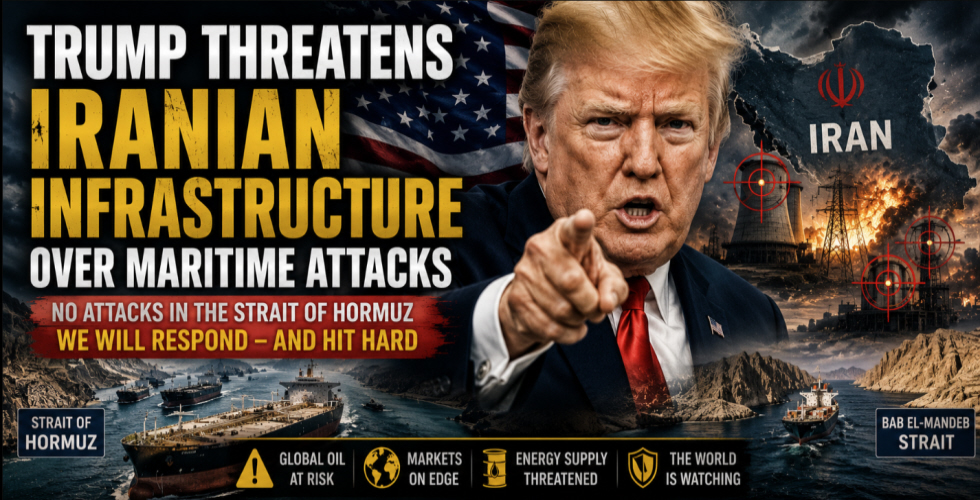
President Donald Trump has sharply escalated tensions with Iran by warning that the United States would launch direct strikes against strategic Iranian infrastructure whenever a vessel is attacked in the Strait of Hormuz. He specifically mentioned bridges, power plants, and other critical facilities as potential targets for retaliation. The statement introduces a dangerous policy of immediate military response that could transform any maritime incident into a broader regional conflict.
The Strait of Hormuz remains one of the world's most vital energy corridors, carrying a significant share of global oil exports every day. Any attack against commercial tankers, cargo vessels, or naval ships passing through the waterway has the potential to disrupt international markets within hours. Washington's message is intended to demonstrate that it will not tolerate attempts to use this strategic route as leverage. Trump's warning places additional pressure on Tehran while increasing the possibility of a direct military confrontation between the two countries.
Strikes against power stations, bridges, and transportation infrastructure would not only affect Iran's strategic capabilities but could also disrupt essential civilian services. Such actions could trigger retaliatory responses involving missiles, drones, naval operations, or allied armed groups across the region. The crisis expanded after Yemen's Houthi movement, backed by Iran, warned that it could move to close the Bab el-Mandeb Strait. This narrow maritime passage links the Red Sea to the Gulf of Aden and serves as one of the world's most important shipping lanes.
Any disruption there would force commercial vessels to seek longer, more expensive alternative routes. Saudi Arabia could become one of the countries most affected by such developments because a large portion of its energy exports depends on stable maritime transportation through nearby waters. The Houthis have suggested they could target shipping connected to Saudi interests if regional hostilities continue to escalate. Prolonged disruptions would place additional pressure on both regional economies and global energy markets. The possibility of simultaneous threats to both Hormuz and Bab el-Mandeb creates one of the most serious scenarios facing international commerce.
Together, these strategic waterways transport oil, natural gas, industrial goods, food supplies, and countless products essential to the global economy. A prolonged crisis affecting both routes could trigger inflation, supply shortages, and increased transportation costs worldwide. Shipping companies are already evaluating alternative routes, enhanced security measures, and higher insurance coverage for vessels operating in the region. Diverting ships around the Cape of Good Hope would add thousands of miles and significant operating expenses to international voyages.
Those additional costs would eventually be reflected in higher prices for businesses and consumers around the world. Trump has framed his warning as a deterrence strategy designed to protect freedom of navigation and ensure that any attack against international shipping carries immediate consequences. Critics, however, argue that automatic retaliation leaves little room for diplomacy and increases the possibility of dangerous miscalculations. A single incident or mistaken attribution could rapidly expand into a wider military confrontation.
Iran, meanwhile, may interpret the American warning as preparation for direct attacks on its territory, prompting an even tougher response from Tehran. Iranian leaders have long relied on regional alliances and strategic influence as part of their broader defense posture. Cooperation with allied groups provides additional options for applying pressure without immediately engaging in conventional warfare.
The latest crisis demonstrates that the confrontation now extends well beyond the relationship between Washington and Tehran. Saudi Arabia, Yemen, Israel, and several regional powers all face growing security concerns as tensions continue to rise. If threats evolve into direct military action, the Middle East could enter a far more dangerous phase with consequences reaching financial markets, energy supplies, and global economic stability.


