
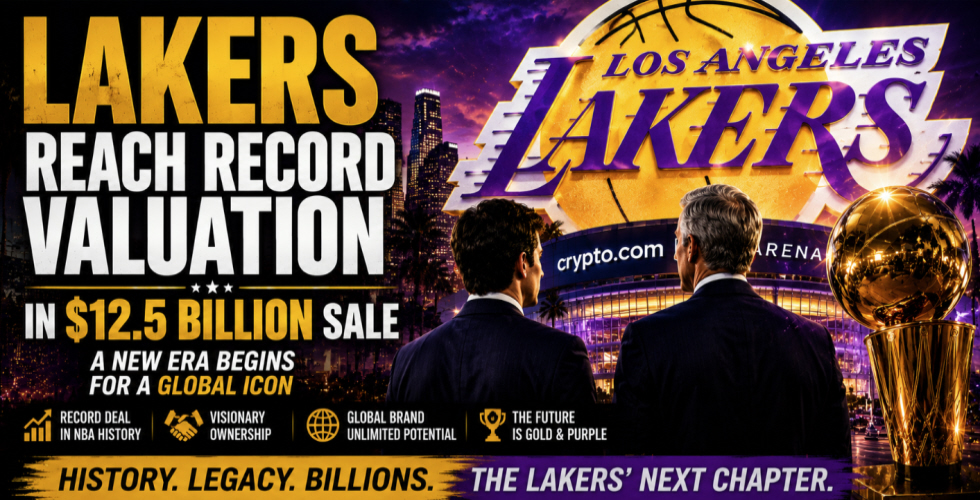
The Los Angeles Lakers are once again preparing for a change in ownership through a transaction that demonstrates just how dramatically the business of professional sports in the United States has evolved. Joshua Kushner and Bob Iger have agreed to acquire control of the historic NBA franchise in a deal valuing the organization at approximately $12.5 billion. The figure would establish a new record for the sale of an American professional sports franchise. The transaction must still receive the required approval from the NBA Board of Governors. The magnitude of the agreement becomes even more remarkable because the Lakers were involved in another multibillion-dollar transaction only last year.
Mark Walter obtained control of the franchise through a deal that valued the organization at approximately $10 billion at the time. Now, little more than a year later, the new transaction raises that valuation to $12.5 billion. The difference represents approximately $2.5 billion in additional valuation and an increase of roughly 25 percent over an extraordinarily short period. That increase does not necessarily mean Walter will automatically receive $2.5 billion in net profit, because the financial structure of both transactions involves ownership stakes, investments and other factors that must be considered.
Nevertheless, the new valuation clearly demonstrates how much major investors are currently willing to pay for control of an exceptional sports franchise. The Lakers are not simply a basketball team but a global brand built through decades of championships, legendary players and enormous international exposure. That combination makes the organization an asset that would be extremely difficult to reproduce. Joshua Kushner enters the transaction from the world of investment and venture capital, where he has developed a significant business career through Thrive Capital.
Although he is also publicly known as the brother of Jared Kushner, President Donald Trump’s son-in-law, that family connection is not the fundamental economic element of this transaction. His participation primarily reflects the growing interest among major private investors in acquiring globally recognized sports assets. Professional sports have become a new frontier for capital that previously concentrated largely on technology, real estate and traditional businesses. Bob Iger brings an entirely different type of experience that is particularly relevant when considering the Lakers’ economic future.
For decades, he was closely associated with Disney and became one of the most recognized executives in the American media and entertainment industry. His knowledge of television, content, branding and international audiences could prove especially valuable at a time when sports franchises increasingly depend on media rights. Combining financial capital with extensive media experience gives the prospective ownership group significant opportunities to develop new sources of revenue around the franchise. The rising value of the Lakers is part of a much larger transformation taking place throughout American sports.
Professional franchises have become extremely scarce assets because the major leagues contain only a limited number of teams and very few premier organizations actually become available for purchase. When a historic franchise reaches the market, billionaires, investment funds and major business groups compete for an opportunity that may not appear again for decades. That scarcity directly contributes to valuations increasing much faster than those of many traditional sectors of the economy. Broadcasting rights represent another powerful force driving this phenomenon.
While traditional television audiences have become increasingly fragmented across digital platforms and streaming services, major sporting events continue bringing millions of viewers together simultaneously. That ability makes sports one of the few forms of content capable of guaranteeing enormous audiences in real time. Television networks, technology companies and digital platforms are willing to pay extraordinary amounts to secure those rights. A significant portion of that money ultimately increases league revenues and, consequently, franchise valuations. The Lakers also possess characteristics that very few sports organizations can match.
Their history is connected to legendary players, numerous championships and generations of supporters both inside and outside the United States. Los Angeles provides one of the most important commercial and media markets in the world, while the NBA continues expanding its international presence. Merchandise, sponsorships, licensing, digital content and commercial partnerships allow the organization to transform its enormous fan base into multiple sources of revenue. Buying the Lakers means acquiring a team, a brand and a global entertainment platform simultaneously.
The transaction also demonstrates that the economic value of a franchise no longer depends exclusively on winning championships or selling tickets to games. Modern owners increasingly seek to develop real estate projects, fan experiences, international sponsorships, digital platforms and new methods of distributing content. The relationship between sports, entertainment and technology is creating opportunities that barely existed a decade ago. In that context, the $12.5 billion valuation of the Lakers also represents a bet on how valuable the entire sports ecosystem could become over the next ten or twenty years.
Paying a record amount, however, also dramatically increases expectations surrounding the future management of the organization. A $12.5 billion valuation requires sufficient growth to justify an extraordinary investment and eventually generate returns for its owners. The prospective ownership group will need to balance basketball priorities with commercial opportunities without damaging the historic identity that transformed the Lakers into a worldwide brand. The challenge will be increasing revenue while preserving the emotional connection that millions of supporters maintain with the franchise.
The speed at which the valuation increased also raises an interesting question about the limits of the American sports market. If one franchise can move from approximately $10 billion to $12.5 billion in little more than a year, other exceptionally recognized properties could eventually command even larger figures in future transactions. Live sports continue gaining economic importance precisely because they retain something increasingly difficult to find in the modern entertainment market: enormous audiences watching the same event at the same time.
As long as that characteristic remains, the most important teams will continue attracting extraordinary amounts of capital. The potential $12.5 billion sale of the Lakers therefore represents much more than another ownership change within the NBA. It demonstrates how American professional sports are becoming one of the most coveted asset classes in the business world.
Joshua Kushner and Bob Iger are wagering a record amount on the belief that a historic franchise can continue growing far beyond the basketball court. If the NBA ultimately approves the transaction, the Lakers will begin a new era in which sports, entertainment, media and major investment will be more closely connected than ever.